Showing posts with label Boston. Show all posts

Tuesday, July 17, 2012

Yummy in My Tummy: Summer Salad Spectacular!

Hi ho there! Greetings from the sweltering heat of this humid Boston summer! Now, granted, I spend most of my days indoors at work or in my air conditioned bedroom (yes, I know, I live a dangerous life -- do not try it at home!), but it is actually impossible to escape the heat. It always catches up to me somehow. Walking home, exploring the city, sitting on the porch, cooking in the non-air-conditioned kitchen, etc. And when it reaches at least 80°F every day, no one really wants to cook in a non-air-conditioned kitchen. I mean, I love cooking, and even I dread the prospect of turning on my gas stove and boiling water for even a minute. Salads, therefore, are basically the lazy, temperature-sensitive chef's best friends in the summer.

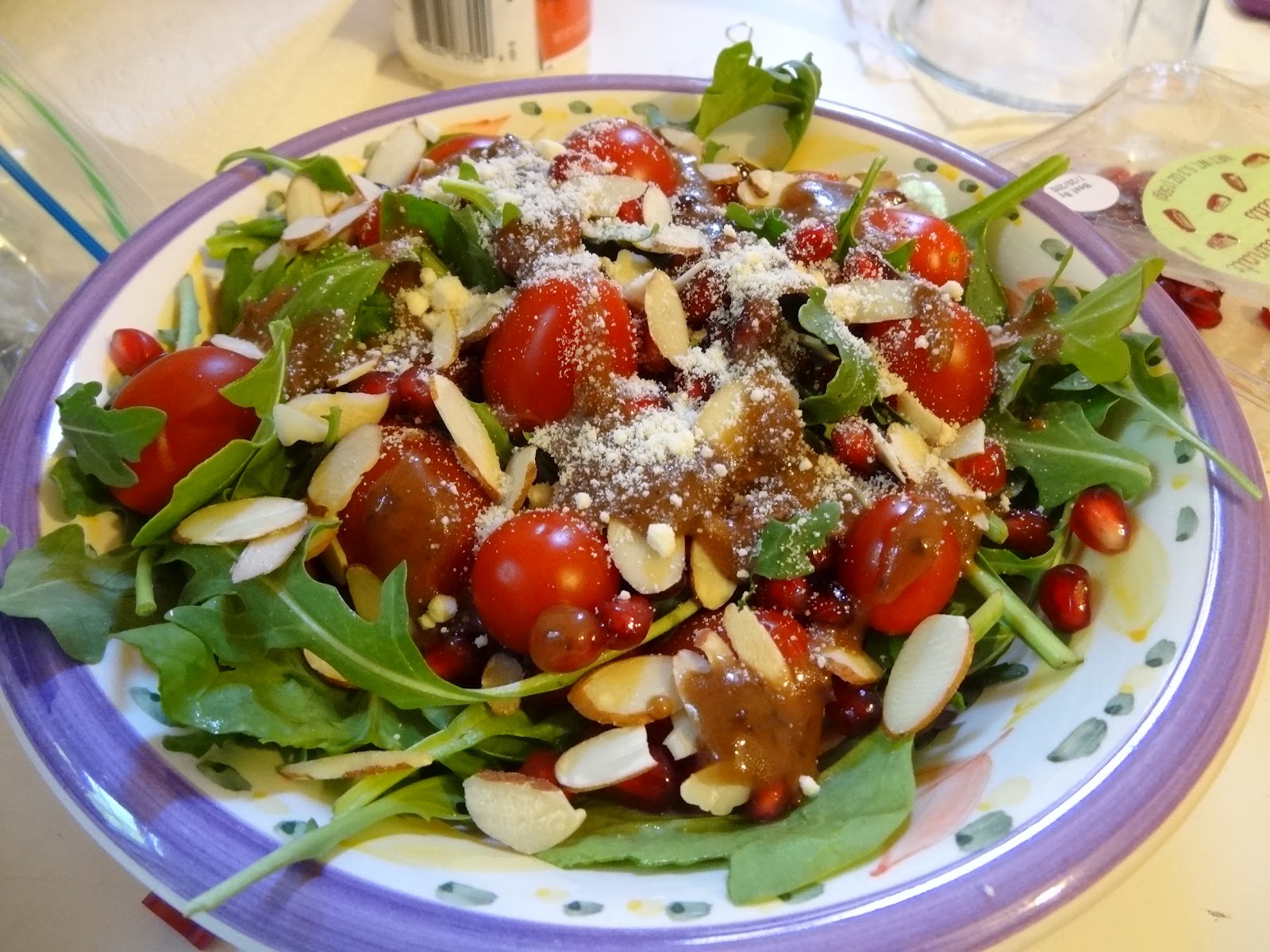
As anyone who lives with me knows, I'm a fan of grabbing whatever is in my fridge and/or pantry and making something new and different out of it. In the case of this salad, I did just that. Here's the recipe:

Almond and Pomegranate Salad


Ingredients:
Baby spinach
Arugula ("rocket" for all you Anglophiles in the audience)
Grape tomatoes
Black beans
Pomegranate seeds
Sliced almonds
Salad dressing
Parmesan cheese (optional)

Directions:
  1. Wash all vegetables and drain. Remove stems from spinach if desirable. Toss greens together in a large salad bowl.
  2. Add tomatoes, beans, pomegranate seeds, and almonds. Mix well.
  3. Drizzle salad dressing over salad. Sprinkle with parmesan, if desirable.
  4. Om nom nom.
Rachel's notes:
There are no specified amounts in this recipe. I measured nothing out when I threw this together after drinking a bottle and a half of white wine with my roommate and her friends. Everyone likes their salad proportions to be a little different, so play around with the amounts and see what works for you. Personally, I love heavier proportions of tomatoes, almonds, and pomegranate seeds because I think the flavors are so interesting and mesh together so well. One of my closest friends would probably choose to use mixed greens over arugula because she can't stand the taste of it. My roommate in France would have refused to eat the tomatoes. Salad is very much what you make of it, but I felt that this had to be one of the best salads I had ever tasted. And I'm not saying that because I was a little tipsy at the time. I replicated this recipe the very next night when I was 150% sober and still thought it was the best thing since cream cheese. This was a very last minute decision for a meal and it turned out marvelously.


Special note on salad dressing:
I don't usually make my own salad dressing. In this case, at any rate, I didn't. I used the Tuscan Italian Dressing with Balsamic Vinegar from Trader Joe's, and it worked great! I have a default salad dressing that I go to, however, when I run out and am too lazy to run to the store to buy more. I haven't tried it on this particular salad, but based on my past experience with this dressing, it would be a great match! I thoroughly encourage you, dear reader, to try it out and tell me what you think!

Walnut Salad Dressing

Ingredients:
2 Tbsp vinegar (red wine or balsamic)
4 Tbsp walnut oil
1 tsp Dijon mustard
Salt, pepper

Directions:
Mix together all ingredients, stirring aggressively as dressing is apt to separate.

This should easily make enough for 2 people to have salad dressing.

Wine of the Meal
Green Fin 2010 White Table Wine 


This is one of the really cheap wines that you can buy at Trader Joe's for about $4 (maybe even less back home in CA, since two-buck Chuck is three-buck Chuck in MA) and is surprisingly good. Normally, I steer clear of table wines because, as experience with French table wines taught me, they normally taste like someone poured some ethanol into some grape juice. However, my current roommates insisted that it was worth a try one night when they were cooking and, boy, was I surprised!

It's somewhat citrus-y, but mostly sweet and fruity (yeah, yeah, citrus usually equals fruit, but I mean something more like mango here). People who know more about these things would likely say that there are oak overtones or something like that. Maybe. Personally, I think it's the perfect wine to share after a long day at the lab as you sit out on your front porch, waiting for the temperature to go down, trading stories with your friends. It pairs pretty nicely with this salad and is a surprisingly good companion for ice cream, as I discovered this evening.


Frankly, it's a cheap wine that doesn't offend my inner scientist (why would I pay to drink ethanol and grape juice when I could make it for free at work?), helps cool one down on a hot day, and doesn't do a number on my wallet. That's a solid wine in my book.

That's it for this week! It's shorter than the last Yummy in My Tummy, and future entries will probably be somewhere between this one and the first one in terms of length and depth. To make up for the simplicity of this week's recipe, I leave you all with a question: What is your favorite summer salad? Leave recipe suggestions in the comments!

Peace, love, and pomegranates,
Rachel

Tuesday, August 10, 2010

Restaurant Review: WHERE IS MY MEXICAN FOOD?!?!

I have been on a Quest. For two years. This Quest has been so Epic that it has taken every last ounce of my willpower to not break down, throw myself on the ground, and start screaming "IT'S HOPELESS!!!" at the top of my lungs. Yeah, it's been that intense.

For the past two years, I have been on a Quest for (Semi) Authentic Mexican Food Somewhere in the City of Boston [Q(S)AMFSCB for short].

I wasn't asking for much. I knew from the beginning that I would not be finding any El Co here in Bean Town. But I was at least hoping for something that was ever so slightly more authentic than the white-washed tacos my family of solidly European descent can create for a tasty evening meal. In all honesty, I was merely praying to any deity that would listen that I would not be doomed to go to Taco Bell to get my fix. And that was assuming that they even had Taco Bell on the East Coast.

I did not realize it would be so hard. (My roommate would probably be shouting "That's what she said!" right now if she were reading this.)

I figured that the Q(S)AMFSCB would probably be along the lines of searching for a needle in a haystack: difficult and taxing and unnecessarily long and nigh impossible for someone like me who, even with infinite amounts of patience, still demands some sort of instant gratification. Instead, I have decided to liken this experience to getting wisdom teeth pulled without anesthetics while looking for a dark grey needle in a stack of black needles after sunset during an earthquake. In the middle of a blizzard. Without shoes.

Ok, so my tendency for hyperbole is starting to get the better of me. But Southern Californians be warned: New England is not friendly to authentic Mexican food. They just don't quite understand what goes into making a genuine burrito. And I finally figured out why.

After months of agonizing over why it was that Bostonians can't comprehend the difference between a grilled steak burrito and a carne asada burrito, I finally came to an astounding revelation (with the help of the post-doc I was working for): Flavor is a foreign concept. The tacos and burritos of Taco Bell, Chipotle, Qdoba, Boca Grande, and so on, will do to satisfy a desperate woman in need of something warm and wrapped in a tortilla. But they just aren't flavored correctly. I still haven't nailed it down, but it's something in the spices; the seasonings are all wrong. These hunks of meat and rice stuffed into tortillas are often bland and lack the full, rich flavor of Southern California taco shops. You can't just grill up some chicken, throw it on some rice, beans, and cheese, add a little salsa and call it day. You have to cook your burritos with care. You must grill with spices: oregano, red pepper, cumin... I don't exactly know what, but something that will add a little extra kick to what you are creating. Use fresh pico de gallo. Add some guacamole that is a secret recipe handed down through the generations of the family that owns the restaurant. And for Heaven's sake, would it kill you to use a corn tortilla? A taco or burrito is not a taco or burrito unless it has a Spanish sounding name and tastes like heaven.

So after an agonizing search, suffice it to say that I was ready to give up. Yes, dear reader, it was nearly too much for this Californian to take. I mean, there are only so many fake burritos that one can consume before one goes insane and starts massacring the whole town with naught but a stiletto and a whole lotta determination.

And then, as luck would have it, my saviour came in the form of an unexpected find in the midst of one of my wanderings through metropolitan Boston. While wandering through Coolidge Corner and up and down Harvard Street, my Q(S)AMFSCB finally came to a pleasant conclusion as I encountered a small restaurant by the name of Dorado.


This place was a dream come true. I was, as one might expect, quite skeptical at first when I noticed the sign outside of the establishment that read "Baja California-style fish tacos," but out of an insatiable curiosity, I decided to check this place out.

First off, the food looks like this:


And if that doesn't make your mouth water... well, then, you might be an alien. Or dead. Either way, I am impressed that you managed to get this far into my entry. Unless you are just looking at the pretty pictures.

Ahem. Anyway.

The above photo is the dorado fish taco, which is the spicy version of the ensenada taco, which, in turn, is the Baja California-style fish taco. And it does everything right. Now, of course, this may not be the perfect taco - I, in fact, have never been to Baja California, so I have never consumed a real taco from there. However, I have been to Rubio's. Many, many times. And they are famous for their authentic Baja California-style fish tacos. So I know what to look for here. And this taco has it all: two corn tortillas, shredded cabbage, fresh pico de gallo, beer-battered and fried fish of indeterminate origin, and spicy chipotle sauce to boot. My stomach is growling at the mere thought of such a scrumptious composition. There are even a couple of radish slices to top the whole thing off!

And that is just the taco. When I was there, I purchased the two-taco plate, which includes two tacos, a side of Mexican rice and black beans. And these are what really make the meal complete. The Mexican rice is flavorful and just the right color orange while the beans are neither runny nor congealing into a bean paste.

The flavor is there. The spice is there. Maybe it isn't the most authentic taco in the world, but when I took my first bite of this glorious dish, I nearly cried. And I had barely finished my plate when I was overcome with the desire to call home and share this fantastic find on Ye Olde Streete o' Harvard with the parentals. It was pure, homesickness-alleviating, mouth-watering bliss. And for less than $10 total. For dinner. In Boston.

Friends, this is exactly what I had been searching for.

Boston, thank you for not failing me forever. You may be a difficult mistress, but at least you reward your loyal followers in the end.

People of the world, go to this restaurant. Eat a fish taco. Discover nirvana for less than $10.

I am dead serious.

It was that amazing.

Elf out!

Wednesday, July 28, 2010

I Apologize for the Delay

Life, as always, got in the way of my attempt to focus more on my writing, and on this blog in particular. However, I am committed to this blog and shall try to update weekly as promised. Or at least monthly. I owe y'all monthly at least. And now, on to some good, old fashioned Bean Town architecture.

I've always had a passing interest in architecture ever since I took AP Art History my senior year of high school. Gothic architecture and some of the modern work by people such as Frank Gehry in particular caught my fancy. When I first arrived in Boston in August of 2008 to attend Wellesley, I was impressed with the buildings squished together around me on the streets. The architecture here is almost nothing like that of San Diego. Southern California has a much more youthful, spread out feeling to it, with heavy southwest influence in the ever-present stucco and earthen tones of so many buildings. Boston, on the other hand, is old and rich with history that San Diegans can't even begin to imagine.

And so I invite you to take a virtual journey with me to some of my favorite buildings in Boston that I have come across thus far. This will likely be the first of many entries about architecture I come across.

Today's entry will focus on three buildings in Copley Square, which is a very busy, tourist-filled area of Boston, especially around this time of year. Here's a photo I took of part of Copley Square on a recent outing with a friend:


And that, unfortunately enough, is not the side of Copely Square which we shall be discussing today. Instead, we will turn to the left and start with one of my favorite buildings in all of Boston: The Old South Church, also known as the New Old South Church. The reason for this strange nomenclature is that the Old South Church congregation had been around much longer than this building had. This was the "new" building that was created for a congregation that had been around since 1669. In fact, the congregation, a part of the United Church of Christ, is one of the oldest religious communities in the United States. Can your religious community claim that?

I love this building because of its ties to Gothic architecture, which captured the heart of my inner art enthusiast three years ago.

Completed in 1875, "the most beautiful basilica in North America," according to the Boston Transcript, was designed in the Gothic Revival style by William Sears (not of the department store fame) and Charles Cummings (a man with a very unfortunate last name). It became the third home of the Old South congregation. This Gothic Revival style particularly reflected the architecture of the cathedrals in Venice, as was advocated by John Ruskin, an influential English architecture critic. The exterior of the building if constructed mostly of puddingstone and deep rose sandstone to create an alternating red and white exterior that is also relatively common in Spanish architecture as well (google images of places in Cordoba, if you don't believe me).


The campanile, or that gorgeous tower attached to the building that most Americans probably couldn't climb without getting seriously dehydrated, is two hundred and forty-six feet tall, and houses a bell that weighs 2020 pounds. That's right, the bell weighs less than your environmentally-conscious Prius and is about 1/13 the weight of the largest bell in the Notre Dame cathedral in Paris. Quasimodo laughs at your puny bell, Boston. For shame.

All jokes about the Hunchback of Notre Dame aside, the Old South Church is thriving in the center of a city famous for people who can't pronounce their "R"s, beans, and tea parties. It currently is home to more than 650 Bostonians from every background you can imagine. They even have a female Senior Minister. Yeah, progress! For a church who once had a man named Ebenezer Pemberton as their Senior Minister and baptized Benjamin Franklin when he was born, I'd say they're doing pretty well for themselves.

One of my personal favorite tiny details of this building happens to not be on the building at all but on the iron gate that surrounds it:

Now, this I can tell you nothing about other than I found it to be especially pretty and so I snapped the above image.

Directly across the street from the (New) Old South Church is the McKim Building of the Boston Public Library, which certainly puts the Balboa branch of the San Diego public libraries to shame, and will possibly be put to shame by the new design for the Central Library in San Diego. However, as far as libraries go, this one is pretty... how shall I describe it? Well, "baller" seems modern and colloquial enough, despite the fact that it is normally applied to people.

Built in 1895, the McKim building was heralded as a "palace for the people" and currently contains the Library's administrative offices, exhibition rooms, and research collection. The building was designed by Charles Follen McKim in the Renaissance Revival style. Why everyone in Copley Square chose to design something in a revival style is beyond me, though I figure it's probably because these people knew good architecture style when it stared them in the face. No need to invent something new when there is already something perfect available, right? The exterior facade was heavily influenced by the Bibliotheque Sainte-Genevieve in Paris whereas the enclosed courtyard pictured below was modeled after the Palazzo della Cancelleria in Rome.


There are all sorts of interesting little symbols and details throughout the library that, in order to cover them all, I would have to create an entire post devoted to this building alone. My personal favorites are the two large statues in front of the library that represent Art and Science;

the head of Minerva (known as Athena to the Greeks), goddess of wisdom, over the main entrance;

the marble lions that proudly, if lazily, lord over the stairs and memorialize the Massachusetts Civil War infantries;

and the fountain in the Italian-inspired courtyard with the statue of the Baccante and Infant Faun in bronze.

For someone who normally misses the heavy symbolism that laces the art and literature of the world, I certainly appreciated all of obvious influences, references, and blatant copies that I found throughout my wanderings of the McKim building. The one aspect I did not appreciate as much was the never-ending stream of religious paintings that seem to be a requirement of any building built before 1900. If I've seen one Crucifixion of Christ, I've seen them all. Please, stick to the clever personifications of great over-arching terms like "Art" and "Science." Kthxbai.

I should clarify. I'm not anti-religion or anti-Christianity, but I always enjoyed the mythology and symbolism associated with ancient Greek and Roman societies so much more because there was so much more to pull from: gods, goddesses, demi-gods, heroes, titans, satyrs, nymphs, and so on. When I studied early Christian art, however, I saw the same twelve scenes or so repeated over and over again and quickly grew bored with the subject matter. Also, gruesome pictures of a crucified Christ do not really seem appropriate in a place of research, which is not a place of worship.

The last building I would like to share with you today is across the square from the Old South Church and is where I would like to stay when I am a wealthy doctor married to a man who has more money than either of us would ever know what to do with. My friends and I originally (and quite literally) stumbled into this building when one of us announced that we needed to use the ladies' room sometime soon or Bad Things would happen. Imagine our surprise when we walked through the doors of what looked like a normal, though not cheap, hotel, and were greeted with the below sight:

Everything in white marble and gold leaf... rugs that probably cost more than my yearly salary... chairs that might be actual Louis XV chairs from the time of the old French king himself. For someone who considers freshly laundered sheets a luxury, I certainly was impressed. My eyes were bugging out of my head, my jaw had dropped onto the ground, and my mind was desperately trying to not calculate how many lifetimes my family would have to work to afford what was in the lobby alone.

This is the Fairmont Copley Plaza. The hotel's architect was Henry Janeway Hardenbergh, the same man who designed the Plaza Hotel in New York City. The hotel opened in 1912 to host more than 1,000 guests, some of whom had had to make reservations for the hotel up to sixteen months in advance for a room. Currently, the hotel has 383 rooms that range in price from $259 per night to $3,500 per night. Among several of its impressive facts and anecdotes, this hotel was the first to be completely air conditioned and was the first to accept credit cards. The Fairmont, which was built on the original site of the Museum of Fine Arts, has been the hotel of choice for nearly every president since William Howard Taft, as well as several foreign dignitaries, celebrities that attract paparazzi like carcasses attract flies and maggots, and various royalty.

And if that doesn't impress you, then consider this: they have a hotel WITHIN the hotel on the fourth floor, open to a "selection of like-minded guests," where "your individuality is valued, your room preferences are honored, and your arrangements for a quick and effortless departure are anticipated." This is all taken directly from their website. They not only arrange your limousines for you, but even provide you with a bottle of mineral water to go along with your bath. Oh, and just to remind you, this is a common sight in the ballrooms:

Meanwhile, this is their bar/lounge:

Feeling outclassed yet? I definitely had a Julia Roberts in Pretty Woman moment when I stepped into this place, and had another one while I was doing the research for this entry.

Awesome.

So that's all for now. More soon. Peace, love, and pandas!

Wednesday, July 14, 2010

A Nice Place to Visit

This


is my current desktop wallpaper. I captured this image on my most recent travels to the Most Beautiful Places in the World.

This


is what that exact same place looked like in April of this year. I think this place certainly warrants a Seasonal Lusciousness of the Year award. Or perhaps the Ugly Duckling that Grew Up into a Beautiful Lake award.

Ok, enough capitalization. It is making me seem pretentious. Also, the lake wasn't really that ugly in April. Just nowhere near as green.

These two pictures, as I mentioned, come from one of the most beautiful places I have ever been: Wellesley College. No, this is not an underwater institution, as might be suggested by these images. That, unfortunately, would be too badass to ever bring into existence. Also, the lead levels in the sediment of the lake make it not-so-safe for underwater undergraduate schools. The actual campus is on the other side of the camera, facing Lake Waban, and is one of the most prestigious colleges in the world, as well as the most well-respected women's college in the nation. I am more fortunate that I can even comprehend to be able to attend this school.

What is so sickeningly wonderful about this place is the actual, physical location of the school. It is in the town of Wellesley, or as I like to call it, upper middle-class suburbia where the nightlife is non-existent and the cheapest stores are CVS, Starbucks, and the Gap. Luckily for us Wellesley women, this means that we are surrounded by trees and pretty houses and scenic routes. We have a lake on the edge of campus. We have our own arboretum. Our buildings are Neo-Gothic and old, so they make those lovely creaking noises when you step on just the right plank of wood on the floor. There is a sense of sophistication everywhere you go - even when you go to the Science Center, which sticks out like a sore thumb and then some. And that is how you fall - hook, line, and sinker - for the school.

I am an Admissions Student Assistant during the school year, and I know for a fact that many, many high schools girls are romanced not by the academics, not by the social life, but by the red bricks of the centenarian buildings and the sweet, wafting scent of the blooming magnolias in the spring. Of course, they have already come to the school with some idea of our excellent academic reputation our unique situation in which students are very, very much in charge of their own social lives. These are the reasons for which I originally applied to Wellesley College, in fact. And these reasons are nothing to be scoffed at. However, when it comes to romancing a student, to setting her imagination ablaze with desirable images of studying on the bench near the Paramecium Pond under the shade on a nice, autumn day, of strolling around the lake just as the sun as started to set over the trees and turn the sky into dazzling shades of pinks and oranges, and of finding oneself in an impromptu snowball fight after class in a winter wonderland... yes, when it comes to all of that, Wellesley's campus cannot be beat. Simply put, my school is gorgeous.

And yet. And yet...

I think there must be some sort of agreement between the weather gods and the big wigs at Swells in that the true face of New England weather may only rear its ugly head once students have actually enrolled in the school. And I think this because the two things they never tell you about the weather are 1) the rain, and 2) the humidity.

Let's start with the rain. I've seen rain before. I've danced in the rain before. I've walked home without an umbrella in the rain before. But I had never, ever seen rain like this:


Buckets (literally, buckets) of rain falling from the sky, drenching people within seconds of stepping outside. Torrential downpours that would put monsoons to shame. Flooding that threatened to not only destroy the 2012 class tree freshly planted by the lake, but that also threatened to turn Wellesley from a beautiful forest dotted with buildings to a swamp that required swamp boats like the one in The Waterboy to get around. I honestly thought rain like that was only used in movies for epic battle sequences (reference: Lord of the Rings: The Two Towers) or make-out scenes (references: The Notebook and Match Point).

Ok, so I exaggerate a little, but when you have to walk across that campus to get to class at 8:30 am, and it's pouring down rain, you'll know exactly how I feel.

You will also come to understand the exact need for rain boots.

When I was a naive, foolish thing, I was under the distinct impression that rain boots were for fashionable, young mothers who wanted their children to be extra prepared and super cute in the event that it ever even drizzled outside. To me, galoshes were just part of the rain wardrobe, along with the bright yellow rain coat/poncho and the bright yellow sailor's hat. Everything matched, and everything was made with extra special care to make that your child never, ever had to get wet. Even though she or he was probably dying to rip the darn things off and go streaking through the rain-soaked streets. Oh-ho-ho, how wrong I was.

Along with more winter clothes that I believed anyone ever needed, galoshes were my first major clothing purchase after moving to the east coast.

Now, let's move on to our second topic: humidity. To someone from Southern California, like myself, humidity is a vague concept that usually means that the marine layer has not burned away yet, or that it might rain at some point later in the day if we're really lucky. It is also something that only comes onstage during the last act of the year when the temperature actually dips below 65 degrees and everyone complains about the cold and the clouds (this is called winter in SoCal).

Meanwhile, in Wellesley, and apparently in the rest of Massachusetts as well, humidity is something that never goes away, and is most noticeable when you most wish it would evaporate (no pun intended), notably in the summer. Here, in Boston and its surrounding suburbs, the humidity is as much likely to get your shirt completely wet as the rain is. 85 degree Fahrenheit weather, sun, and humidity mean more sweat than you ever thought possible for one person to secrete in a 30-minute period.

My boss is from the southern tip of Sweden, so we are both originally from climates that experience dry heat. The idea that you can step outside and feel like you are breathing in water when you haven't jumped into a pool yet is at once bewildering and frightening to the two of us. Try asking us about the weather sometime after we have just walked to work. You shall get more than earful.

Seriously, I would not have changed my mind about coming to study at Wellesley if I had known about the rain and the humidity, but I would have liked to know that I was moving into a giant greenhouse before I showed up here. I especially would have liked to know that, in the summer, the humidity seems to double in evilness. I would have stocked up on t-shirts to sweat through if I had known it would be so humid. I also would have bought a snorkeling mask because it honestly feels like I am swimming some days when the humidity reaches levels known and "unbearable" and "ludicrous."

But maybe I am just prone to complaining. My mother certainly used to think so when I was younger.

In summary, I love Wellesley. I believe it is the only place where I could be half as successful and well-rounded as I have become. There is no other institution in the world where I could meet such wonderful people, receive such an excellent education, and experience such breathtaking views as the picture at the beginning of this post. But I could never live here. I could never take up permanent residence here. I need somewhere that looks like this when you look one way:


and like this when you look the other way:


And this is what it looks like in the middle of January.

Call me spoiled, but San Diego, home of In-N-Out and authentic Mexican food, will always be my one true home.