Showing posts with label history. Show all posts

Monday, March 14, 2011

Less Talking, More Pictures

So I briefly considered writing another monster post about the towns and impressive sights that I have seen, but I realized early on that I didn't have an much to say about these places as I would have liked, and I was getting very tired of having to reference Wikipedia for information. Thus, I decided to do this next entry based on the pictures I took. Each region will be labeled and each picture will be captioned with a little explanation or story. This way, I can share these places before getting back into the monster posts about my holidays in Paris and Italy! Let's dive right in with a trip from last semester.

The Luberon
Deep in the heart of Provence lie three mountain ranges known as the Little, Big, and Oriental Luberon... collectively, they are known much more simply as the Luberon (or Leberon in Provençal, I recently learned). Now, while this sounds like the set-up for a rather lame, and slightly racist, joke or television episode, the truth of the matter is that the Little, Big, and Oriental Luberon mountains are gorgeous. The towns and villages are nothing if not picturesque, sitting high atop the hillsides or laying down low in the Luberon valley. This place is a popular tourist destination for other French citizens as well as British and American tourists who flock to Provence and Côte d'Azur in the summer months. I only had the fortune of visiting this charming location for one day, but my visit was pretty unforgettable.
Château de Lourmarin: The first castle in Provence to be built during the Renaissance. We didn't get to look inside - merely a quick drive by to take pictures.
The Luberon valley, with all its gorgeous greenery.

The rooftops of Bonnieux, a hillside village where, reportedly, John Malkovich owns a home. With a view like that, who wouldn't want to live there? I especially love all the old roof shingles that appear to change color with age.
The Château de Lacoste, one of three homes to the infamous Marquis de Sade in Vaucluse: a medieval castle that his family acquired in the 1600s. Sade renovated the castle in the late 1700s, but it was then looted during the Revolution (that would be the French one). Today, it hosts a grand arts and music festival each year within its ruins and is the second home of Pierre Cardin, a French fashion designer.
Vineyards! There are many, many vineyards in this region, and we passed by field after field of grapevines en route from one destination to the next. The Luberon is quite a good spot to have a small vineyard in the back of your estate if you are like Peter Mayle and decide to leave the boring world of England behind for the culturally intense world of Provence. I highly suggest you read his novel A Year in Provence. I loved it. And for anyone who has ever lived in Provence, you will find yourself frequently chuckling at his spot-on descriptions of the people and the land.
This was my first glimpse of the rocks and cliffs surrounding Roussillon. I couldn't believe it when I saw it. I was so accustomed to the bland, pale color of the mountains that I had seen elsewhere that I was shocked and awed by the brilliant colors of the natural rock formations. Let's look at some more examples, shall we?
This is one of my favorites. I just love the contrast of the green plants with the cliff... and how well the little yellow leaves match their surroundings.
This looks like someone took an abnormally large paintbrush and a had fun.
The day was still young and the sky, though not particularly menacing, still  seemed to threaten more rain to accompany the dew that had yet to evaporate from these fresh, green leaves. The tiny thread of a spider's web was a nice touch to the photo, I felt, even though spiders usually make me run screaming across the room/street/country in terror.
There was no explanation for this door - no sign, no signature that I noted, no notice of any kind to explain this magnificent artwork. But then again, does art need to be explained and titled and categorized? Sometimes it's pieces like this, that you find on garage doors or on metal doors over shops closed for the night, that are some of the most fascinating pieces you will ever see.
The Hôtel de Ville, or so we think. The town was mostly empty on this particular Saturday morning, so it  was difficult to tell. However, when a building it decorated with that many flags, one can usually be certain of its identity as that of the Hôtel de Ville. Possibly the most charming building I have ever seen for such an official place. Also, take note of the color of the building, for the vast majority of buildings in Roussillon are this color as they dug up the stone from nearby quarries.
Portion of a vine hanging over another building not too far from the cliffs that you saw a few pictures ago. I can't be certain (because I can't honestly remember), but this might be part of the 154 year old vine that covered one façade. Even the stems of the vines are in harmony with the mountains.
We stopped for lunch at a five-star restaurant in Gordes, the city that you see here, which was also featured in the movie A Good Year, starring Russell Crowe - worth watching if you are ever in the mood for some southern French scenery and a little Marion Cotillard. Gordes is also mentioned frequently in the works a Peter Mayle, a British author who moved to Vaucluse in the late 1980s and has since written several novels and memoirs set in Provence.
Our entrée, or appetizer as we Americans like to think of it, was a delicious dish made from local mushrooms. I never figured myself to be one for mushrooms. On pizza? Sure. In a pasta sauce? Can't be too bad. On their own? Highly debatable. However, this mushroom in a parsley mousse garnished fresh leaves and a... whatever that was (I have no memory of its name) was mouthwatering to the extreme. Heaven in a mushroom. Oh. My. Goodness.
The "plat," or entrée in the United States (seriously, U.S., WHY U NO CALL COURSES BY RIGHT NAME?), or main course to the rest of the English-speaking world, was delicious, but actually couldn't match the wonderfulness of the mushroom. Guinea hen over risotto with a green onion garnish - a delightful sampling of a poultry I'd never had the opportunity to munch on before.
Dessert: a traditional crème brulée with fruits rouges (that would be the strawberries, raspberries and red currants that you see there) that we actually got to crack with our spoon, just like everyone always dreams of doing. Delicioso. This entire meal, including the champagne apératif and the red and white wines that we tasted, was courtesy of our program director, who special ordered the entire three-course delight. She repeated the story proudly to me several times: how she had called to book the restaurant, how she had not been satisfied with the menu, how she personally got in touch with the chef and asked that THIS is what we be served or she would take our patronage elsewhere, how in the end she got her way as she almost always does. Fantastic.
This is the Abbaye Notre-Dame de Sénanque in the valley below Gordes. It was our last stop for the day and included a guided visit of the abbey by a wonderfully lovely man whose name I am not certain I ever learned unfortunately, but I can tell you that he was one of the most eloquent and kindest of tour guides I have yet had the pleasure of listening to in France. But I digress. This abbey is a Cistercian monastery and its celebrity comes from its lavender fields, of which you can see a small part in the foreground of the photo.
The lavender blooms in June and July, unfortunately, so I don't have any pictures of the gorgeous lavender plants in bloom, but you can google those for yourself and get photos that are more professional than my shots will ever be. Our visit in the late autumn, however, was still lovely, even if it was dark and raining when we finally left the abbey.
This is the cloister, which is supposed to resemble the garden of Eden, i.e. paradise on Earth. This might be the closest any cloister I have seen has ever come. They say that the cloister is Arles is the prettiest cloister in all of Provence, but I don't think that's true. I feel that this one wins, hands down. Not only is this one better maintained, but it has a more attractive and peaceful quality to it.
Another shot of this cloister, from the opposite end, this time at dusk.


Nîmes et le Pont du Gard


Nîmes is a city about an hour and ten minutes west-northwest of Aix-en-Provence and is a popular tourist destination. Similar to Arles, it has an ancient elliptical Roman amphitheater that was once used for medieval housing: families lived inside the arena, whose walls and towers served as ramparts for the tiny community within. The Maison Carrée is also a popular place to see; it was once a small temple to the Roman gods. However, for many people who come to Nîmes, the first thing that comes to mind is the Pont du Gard, a Roman architectural masterpiece that still functions as a bridge but has long ceased to be used as an aqueduct. We came to these locales as part of an Erasmus student excursion that I have mentioned once before in my first post on tiny Provençal towns. Organized by the office of international relations at Université Aix-Marseille 1 and run by a local tour company, this trip at the beginning of the semester is open to all international students and offers us a way to not only explore the region in which we are living, but to meet the people with whom we are inhabiting it. This was the first excursion of any sort with the new students for the spring semester, and I was excited to get to know them a little bit. Turns out, we were all a little too preoccupied with the sights to do lots of bonding. Not that anyone was particularly worse off because of that...
Le Jardin de la Fontaine. This was our first stop on our brief tour of Nîmes. Like many French gardens, white gravel seems to be of the utmost importance. One cannot properly crunch across the garden in dainty shoes while discussing all the latest gossip of who is to marry whom while carrying lacy white parasols to shade one's porcelain skin from the sun without white gravel! Or something like that.
Interior of what is thought to have once been a temple, possibly to Diana, but could have also been a library for all we really know since it doesn't really have the shape of a typical temple from way back when. Can I just remind you once again of how I simply love ruins?
This was right next to the temple in a little courtyard. I wonder what it might have looked like 1800 years ago? That little nook right in the back there looks to be the perfect spot to curl up with a book. Perhaps this was a library after all...
This is the arena of which I spoke earlier. It reminds me very, very much of the arena in Arles. I like how these amphitheaters all look alike to some degree. I suppose it must have been nice for a Roman to travel from city to city and be able to find his or her way easily enough if the forum, temples, arenas and theaters all used the same sort of architecture from one colony to the next.
This is the current coat of arms of Nîmes: a crocodile chained to a palm tree. Despite the palm trees that I saw there, which were most certainly imported, I saw not a single crocodile chained up anywhere. Disappointing? Yeah, kinda.
And here it is! The magnificent Pont du Gard! And, boy, is it big! I haven't the faintest idea why, but I had never imagined it to be quite so large. It spans an entire valley between two hills after all, so how can it not be of epic proportions? I suppose it is just something that you can't put into perspective until you are actually standing right up alongside it.
Just as breathtaking as the aqueduct was the scenery. The Gard River was a gorgeous blue that day and it was as though we had been transported to a different era. There was hardly a modern building to be seen in any direction (excepting, of course, the one house - guardhouse? - that is likely three hundred years old), and as we walked the not-so-well-worn path up one side of the hill and down the other to get to the other side of the aqueduct, I was once again reminded of my love for the outdoors. Ahhhhhhhh. Oh, yes, and it was sunny.
And here is the other side of the bridge - actually a little more magnificent since the sun was shining on it, but who am I to judge sides of architectural feats of magnificence?
Anyone reminded of The Lord of the Rings with this shot? I know I was. I was so ready for Legolas and Aragorn to come dashing out from the trees, fighting Uruk-hai and being awesome. Didn't happen, obviously, but at least it gave my imagination plenty of fodder for hypothetical story ideas.
Peace, love, pandas, and orc-fighting elves,
Rachel

Tuesday, March 8, 2011

It's About Damn Time: Old Ruins, New Sights

Part 2 of 2 concerning Provençal cities, towns, and villages... Let's get the ball rolling in not-quite-alphabetical order.

Avignon

For "les vacanes de Toussaint" (the vacation surrounding All Saint's Day in France), I decided that I would return to a small city along the Rhône called Arles to visit all of the tourist spots I did not have the chance to see the first time around. I knew that there were buses that went there, but I had no idea which buses they were, so I conducted a little research and came to the conclusion that the best way (read: cheapest) to get to Arles via bus was to go up to Avignon first and then catch a bus down and over to Arles -- a little out of the way, sure, but it was not so out of the way as to completely inconvenience the traveler. (I later found out that there is a direct bus from Aix to Arles, but, alas, I learned this vital piece of information too late.)

This was really not a problem for me. I was delighted to have the opportunity to see another Provençal city and get a little more history out of the trip than I had originally planned.

Enter Avignon.
Literally a row of restaurants on the Place de l'Horloge
Yet another small town in the south of France that has been around forever, Avignon is particularly well-known for its Palais des Papes, which is by no means a misnomer. During the 14th century, a series of popes took up residence in Avignon, wishing to avoid the violence and political instability in Rome, and as such, were drawn further and further under the influence of the French crown. Which, you know, makes sense considering that all seven popes who lived in Avignon were, uh... French.

So, Clement V took up residence in Avignon in 1309, and since Avignon was clearly not the religious center that Rome was (is, if we're including the Vatican City in Rome), they didn't have a papal palace yet, meaning that Clement V was humble enough to pass the time in a Dominican monastery. His successor, however, began reconstructing a nearby bishop's palace by turning it into something that really makes one question the whole "vow of poverty" thing that members of the clergy live by.
It's not mine; I just live here and reap the glorious benefits
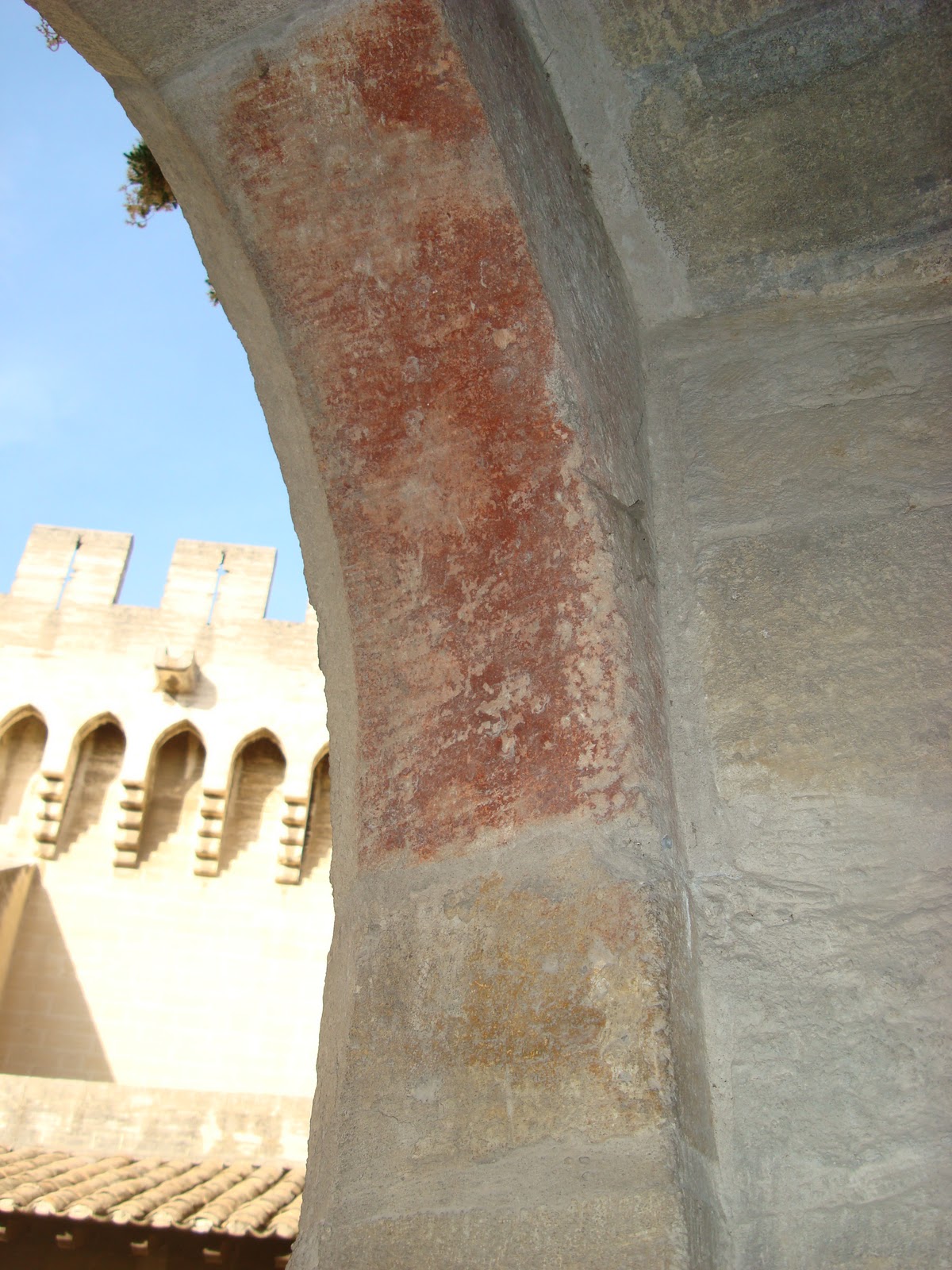
A hefty portion of the papal funds, which I am pretty certain could have been used for more productive things than building a palace (unless they are building it to glorify God - then I suppose we can't really fault them because that would be something like finding fault in or dishonoring God, and that's a no-no), went to building this gargantuan house under Popes Benedict XII, Clément VI, Innocent VI, and Urban V. Clément VI and Innocent VI contributed significantly to the expansion of the palace while Urban V pretty much put the finishing touches on the whole building. Finishing touches such as ceramic floor tiles, fantastic frescoes that adorned the walls and ceilings, and basically lots and lots of color. During the papal occupation, this place would have been more colorful than a rainbow on acid. Unfortunately, all that is left of that magnificent color today are a few tiles and faded, crumbling frescoes and painted walls.


Basically, this place was pretty darn impressive (nothing to Saint Peter's in Rome, I'm sure, but still - not bad) with its grand dining halls and large stained glass windows and Gothic ribbed vaults.

The second place of interest is not far from the papal palace and is nowhere near as magnificent, and yet somehow still as spectacular. It is a bridge: the Pont Saint-Bénezet. This medieval bridge once spanned the Rhône, connecting the city to Villeneuve-lès-Avignon, but suffered from what can essentially be boiled down to bad construction and collapsed several times over the following centuries. It was rebuilt and rebuilt until finally they decided to stop preventing what fate had clearly been telling them for years was meant to be in 1668 when the bridge was virtually washed away by a flood. Today, the vestiges of this once-jinxed bridge are a major tourist destination for people in Avignon, and it's no wonder why. Just look at the views you can get from the bridge:
I wonder if people in the Middle Ages ever stopped to appreciate this same view? Well, minus the sidewalk...
I wonder if the Avignon popes ever admired the view from here? Well, minus the cars...
The bridge itself is pretty cool as well since it just ends in the middle of the river, leaving the uninformed tourist more than just a little curious as to the history behind the ruins.
See that patch of trees just beyond the bridge? That is where the rest of the bridge SHOULD be.
The rest of Avignon didn't strike me as much more than a typical, small French city. That said, I was there for less than a day, so I really wasn't able to take much of the city in, and I enjoyed what I was able to see... but at the end of the day, I was looking forward to reaching my final destination of Arles.

Arles


For someone such as me who loves classical civilizations, Arles is a must-see city. While it is small enough that it can be walked in less than a day and completely exhausted of its treasures in two to three days, it has enough charm and history attached to it to make it worth any weekend getaway, especially when one is in the mood for a small French town.

I first visited Arles as part of an international student tour group and spent a grand total of two, maybe three hours there before being carted off to my next destination. And so I had had it in my mind to make a trip up to Arles at some point during my travels within France. The Toussaint vacation seemed to be the perfect time, so off I went to discover the ancient Roman ruins and the old haunts of everyone's favorite ear-cutting Impressionist.

Like many French cities that have any history at all (read: all of them, duh), Arles is a strange mix of styles and centuries. You can walk along the Rhône and run across the ancient Roman baths built by Constantine, who was a huge fan of the Roman colony, which as far as I can tell went by the name of Arlate back in the day. Then, you can turn to your left and see some nifty modern graffiti on the side of a low wall hiding a dumpster. Walk a little further down and you can spot a ruined wall left over from what might have been an attack during a world war. And let us not forget Les Alyscamps across town, comprised of an ancient Roman necropolis and a medieval Christian church.
Exterior shot of the Thermes de Constantin
Interior shot
"Insure yourself against chance. One look comes so quickly."
The black and white was too irresistible of an option to pass up for this shot.
I have a thing for empty sepulchers and abandoned churches
Arles is a haven for history buffs. Its streets and far corners are laden with centuries upon centuries of rich European history and it is impossible to navigate the narrow streets without chancing upon yet another story pertaining to Arles's 2800 or so years of existence.

My favorite sites, though, focused on the Roman vestiges and the scenic reminders of Van Gogh's beautifully colored French village. The antiquities museum on the outskirts of "centre ville" is well worth the trip for an in-depth look at the development of the city, with plenty of artifacts to sate one's appetite for Roman sculpture, Early Christian iconography, and pottery galore. While I was there, it just so happened that special exhibition centered around an archeological dig done at the bottom of the Rhône not far from Arles. The city had been a major mercantile mecca for people from all over Europe, and as a result, researchers found remains of various types of amphorae and other types of pottery whose names are escaping me at the moment from countries all over the Mediterranean. Since I vaguely understand the importance of such archeological treasures, I had fun comparing the minute differences (and the glaringly obvious ones, as well) between amphorae from select countries and even across continents.

I was even able to study for a midterm while at this museum. My medieval archeology class from last semester focused on Late Antiquity and the early Middle Ages, which is when France was subjected to a widespread Christianization of cities and rural areas. Sarcophagi dating from this period are the perfect visual aides for understanding early Christian iconography and the general transition to a monotheistic society.

And then, the ancient theater and arena. Which are best discussed in picture form.
See those columns? Now imagine that the set was twice as high. Oh, yeah. Theater geek's wet dream. Or nightmare.
It's almost like a graveyard. Which pleases my inner creepiness.
This colosseum is still used today
View of Arles from the top of the tower
Oh, and let's not forget our dearly beloved friend Van Gogh!!!!
L'Espace Van Gogh: the hospital where Van Gogh once lived
I made friends with the waiter my first day in Arles. He invited me back to the restaurant the next day, so I returned with the friends I had met in my hostel. Hope he appreciated the business.

Wednesday, July 28, 2010

I Apologize for the Delay

Life, as always, got in the way of my attempt to focus more on my writing, and on this blog in particular. However, I am committed to this blog and shall try to update weekly as promised. Or at least monthly. I owe y'all monthly at least. And now, on to some good, old fashioned Bean Town architecture.

I've always had a passing interest in architecture ever since I took AP Art History my senior year of high school. Gothic architecture and some of the modern work by people such as Frank Gehry in particular caught my fancy. When I first arrived in Boston in August of 2008 to attend Wellesley, I was impressed with the buildings squished together around me on the streets. The architecture here is almost nothing like that of San Diego. Southern California has a much more youthful, spread out feeling to it, with heavy southwest influence in the ever-present stucco and earthen tones of so many buildings. Boston, on the other hand, is old and rich with history that San Diegans can't even begin to imagine.

And so I invite you to take a virtual journey with me to some of my favorite buildings in Boston that I have come across thus far. This will likely be the first of many entries about architecture I come across.

Today's entry will focus on three buildings in Copley Square, which is a very busy, tourist-filled area of Boston, especially around this time of year. Here's a photo I took of part of Copley Square on a recent outing with a friend:


And that, unfortunately enough, is not the side of Copely Square which we shall be discussing today. Instead, we will turn to the left and start with one of my favorite buildings in all of Boston: The Old South Church, also known as the New Old South Church. The reason for this strange nomenclature is that the Old South Church congregation had been around much longer than this building had. This was the "new" building that was created for a congregation that had been around since 1669. In fact, the congregation, a part of the United Church of Christ, is one of the oldest religious communities in the United States. Can your religious community claim that?

I love this building because of its ties to Gothic architecture, which captured the heart of my inner art enthusiast three years ago.

Completed in 1875, "the most beautiful basilica in North America," according to the Boston Transcript, was designed in the Gothic Revival style by William Sears (not of the department store fame) and Charles Cummings (a man with a very unfortunate last name). It became the third home of the Old South congregation. This Gothic Revival style particularly reflected the architecture of the cathedrals in Venice, as was advocated by John Ruskin, an influential English architecture critic. The exterior of the building if constructed mostly of puddingstone and deep rose sandstone to create an alternating red and white exterior that is also relatively common in Spanish architecture as well (google images of places in Cordoba, if you don't believe me).


The campanile, or that gorgeous tower attached to the building that most Americans probably couldn't climb without getting seriously dehydrated, is two hundred and forty-six feet tall, and houses a bell that weighs 2020 pounds. That's right, the bell weighs less than your environmentally-conscious Prius and is about 1/13 the weight of the largest bell in the Notre Dame cathedral in Paris. Quasimodo laughs at your puny bell, Boston. For shame.

All jokes about the Hunchback of Notre Dame aside, the Old South Church is thriving in the center of a city famous for people who can't pronounce their "R"s, beans, and tea parties. It currently is home to more than 650 Bostonians from every background you can imagine. They even have a female Senior Minister. Yeah, progress! For a church who once had a man named Ebenezer Pemberton as their Senior Minister and baptized Benjamin Franklin when he was born, I'd say they're doing pretty well for themselves.

One of my personal favorite tiny details of this building happens to not be on the building at all but on the iron gate that surrounds it:

Now, this I can tell you nothing about other than I found it to be especially pretty and so I snapped the above image.

Directly across the street from the (New) Old South Church is the McKim Building of the Boston Public Library, which certainly puts the Balboa branch of the San Diego public libraries to shame, and will possibly be put to shame by the new design for the Central Library in San Diego. However, as far as libraries go, this one is pretty... how shall I describe it? Well, "baller" seems modern and colloquial enough, despite the fact that it is normally applied to people.

Built in 1895, the McKim building was heralded as a "palace for the people" and currently contains the Library's administrative offices, exhibition rooms, and research collection. The building was designed by Charles Follen McKim in the Renaissance Revival style. Why everyone in Copley Square chose to design something in a revival style is beyond me, though I figure it's probably because these people knew good architecture style when it stared them in the face. No need to invent something new when there is already something perfect available, right? The exterior facade was heavily influenced by the Bibliotheque Sainte-Genevieve in Paris whereas the enclosed courtyard pictured below was modeled after the Palazzo della Cancelleria in Rome.


There are all sorts of interesting little symbols and details throughout the library that, in order to cover them all, I would have to create an entire post devoted to this building alone. My personal favorites are the two large statues in front of the library that represent Art and Science;

the head of Minerva (known as Athena to the Greeks), goddess of wisdom, over the main entrance;

the marble lions that proudly, if lazily, lord over the stairs and memorialize the Massachusetts Civil War infantries;

and the fountain in the Italian-inspired courtyard with the statue of the Baccante and Infant Faun in bronze.

For someone who normally misses the heavy symbolism that laces the art and literature of the world, I certainly appreciated all of obvious influences, references, and blatant copies that I found throughout my wanderings of the McKim building. The one aspect I did not appreciate as much was the never-ending stream of religious paintings that seem to be a requirement of any building built before 1900. If I've seen one Crucifixion of Christ, I've seen them all. Please, stick to the clever personifications of great over-arching terms like "Art" and "Science." Kthxbai.

I should clarify. I'm not anti-religion or anti-Christianity, but I always enjoyed the mythology and symbolism associated with ancient Greek and Roman societies so much more because there was so much more to pull from: gods, goddesses, demi-gods, heroes, titans, satyrs, nymphs, and so on. When I studied early Christian art, however, I saw the same twelve scenes or so repeated over and over again and quickly grew bored with the subject matter. Also, gruesome pictures of a crucified Christ do not really seem appropriate in a place of research, which is not a place of worship.

The last building I would like to share with you today is across the square from the Old South Church and is where I would like to stay when I am a wealthy doctor married to a man who has more money than either of us would ever know what to do with. My friends and I originally (and quite literally) stumbled into this building when one of us announced that we needed to use the ladies' room sometime soon or Bad Things would happen. Imagine our surprise when we walked through the doors of what looked like a normal, though not cheap, hotel, and were greeted with the below sight:

Everything in white marble and gold leaf... rugs that probably cost more than my yearly salary... chairs that might be actual Louis XV chairs from the time of the old French king himself. For someone who considers freshly laundered sheets a luxury, I certainly was impressed. My eyes were bugging out of my head, my jaw had dropped onto the ground, and my mind was desperately trying to not calculate how many lifetimes my family would have to work to afford what was in the lobby alone.

This is the Fairmont Copley Plaza. The hotel's architect was Henry Janeway Hardenbergh, the same man who designed the Plaza Hotel in New York City. The hotel opened in 1912 to host more than 1,000 guests, some of whom had had to make reservations for the hotel up to sixteen months in advance for a room. Currently, the hotel has 383 rooms that range in price from $259 per night to $3,500 per night. Among several of its impressive facts and anecdotes, this hotel was the first to be completely air conditioned and was the first to accept credit cards. The Fairmont, which was built on the original site of the Museum of Fine Arts, has been the hotel of choice for nearly every president since William Howard Taft, as well as several foreign dignitaries, celebrities that attract paparazzi like carcasses attract flies and maggots, and various royalty.

And if that doesn't impress you, then consider this: they have a hotel WITHIN the hotel on the fourth floor, open to a "selection of like-minded guests," where "your individuality is valued, your room preferences are honored, and your arrangements for a quick and effortless departure are anticipated." This is all taken directly from their website. They not only arrange your limousines for you, but even provide you with a bottle of mineral water to go along with your bath. Oh, and just to remind you, this is a common sight in the ballrooms:

Meanwhile, this is their bar/lounge:

Feeling outclassed yet? I definitely had a Julia Roberts in Pretty Woman moment when I stepped into this place, and had another one while I was doing the research for this entry.

Awesome.

So that's all for now. More soon. Peace, love, and pandas!