Wednesday, March 9, 2011

M is for Marseille... and Monaco

I am totally on a roll.


Marseille

I haven't spent nearly as much time in Marseille as I wish I could have up to this point, but I did make a point of going this port city one day with my friend Derek. We were on a mission to find a beach, catch some southern French rays of soleil and chill like only a southern Californian can. We did some sightseeing along the way.

I like to think of Vieux Port as the heart of Marseille. "Vieux port" literally translates to "old port" and now functions as a marina for local boats. What's particularly cool about the Old Port is that it is a natural port and has been used ever since about 600 B.C. when the Phocaeans set up a trading post there. Ever since, Marseille has been a central Mediterranean hub for trade and industry. This is a large city that feels as though it has been subjected to urbanization on a much grander scale than Paris or any other large city in Ye Olde France because it feels urban and industrial. Paris gives off a sense of haughty sophistication whereas Marseille is a strange "mélange" of southern French comfort and hearty industrialization. For lack of a better term, the place feels working class. Riding into Marseille takes one through the banlieues (the "ghettos" on the outskirts of town), where buildings tower above the 4-6 storey height common to many, many buildings in Paris, in Aix, and so on. The paint is peeling from the walls, the pale blue shutters have turned a dank grey, and the graffiti covers every inch of unoccupied territory. Old buses stand on end in junkyards and the red, green and blue tents of the homeless peek out from under the greenery that frames the highway leading into town.

Also, the beaches are not as nice as San Diego beaches. MARSEILLE, I AM DISAPPOINT. But I digress. This is Vieux Port:
Well, the right side of the marina, anyway
This map of the entrance to Vieux Port dates from 1695.
The city of Marseille, ca. 1720
For all you Dumas buffs out there, Marseille is also the site of The Count of Monte Cristo, a very lengthy novel that I could never finish because I kept wondering when Jim Caviezel was going to appear and sweep me off my feet.
I think he's trying to make love to me with his eyes. And I think it's working.
For those of you who don't know the plot, Edmond Dantès, a naive and ridiculously attractive young man with an equally attractive fiancée is wrongly imprisoned  for treason at Château d'If, a prison island off the coast of Marseille, by those whom he supposed to be his friends *cough*Fernand Mondego*cough*. While there, he befriends Dumbledore, who teaches Edmond the ways of the ninja (pass your hand through the water without getting it wet) and educates him in all things badass (namely, literature, philosophy, swordfighting, and other equally lofty pursuits). Eventually Edmond escapes and tracks down the treasure of the isle of Monte Cristo, which is located near Corsica. After the duckling-swan transformation is complete, Edmond slowly takes his revenge upon those who turned his life into a literal hellhole, reunites with the woman he loves, learns he has a son, and lives happily ever after. All while look smoking hot.

I was under the impression that Château d'If was this ridiculously imposing island - as infamous as Alcatraz and as isolated as Azkaban. Nope. Take a look at this picture.
Hey! That girl looks familiar!
See those islands on the right of the photo, not too, too far offshore? The little island in front is the former island prison of Château d'If. I am 90% certain that I have gone snorkeling that far offshore before by starting at the beach and swimming out there at a leisurely pace. I assume, then, that there must be man-destroying rocks and sharks with laser beams attached to their heads encircling the place, because otherwise, assuming one could get out of the château, I can't see how escaping back to shore would really be much a challenge to anyone who knows how to doggy paddle at the very least, especially when the château is just a bit over a mile offshore. I wonder what made this place, at least in my mind, such a formidable prison?
I don't see any laser-beam-carrying sharks. Perhaps they are hiding, waiting to surprise the unsuspecting escapee.
Ah, dangerous ocean currents, you say, Wikipedia? As well as gun embrasures that I am sure were well-armed with hundreds of sharp-shooters just waiting for someone to attempt a daring escape? That is more acceptable. Although, considering the fact that the detainees were mostly political and religious prisoners, I can't imagine that they were the sort of cutthroat criminals itching to get out and get their hands bloody again. In fact, if anything, the detainees would have been white collar criminals more along the lines of Neal Caffrey, who would have schemed their way from a windowless cell to one with a fireplace and a prime view of the Marseille skyline to right out the front door and on to freedom with nothing but their wits, charm, and sizable cajones.
I like to think that all con men look, act, and dress like this man.
Charming white collar criminals aside and former formidable French prisons aside, I couldn't help but compare Marseille to San Diego. I immediately picked up on the same style of beach-front property design that one can find in La Jolla: tall, skinny homes that are much deeper and larger than you originally imagined, packed tightly together across the street from a set of cliffs leading down to the waves and boats below in some parts... and grandiose, sprawling residences hovering above beaches in other places.
And I bet all of these places cost a least a million euros
I can't decide which one I want for my fourth summer home.
 The beach that we went to was a small stretch of sand protected by a line of rocks that ran along the southern edge, creating a double beach of sorts. The water was a bit too frigid for my tastes, so I sunbathed and read up on early Christian history in Byzantium while Derek, the brave soul, went clambering over the rocks and tested the water on both sides of the sand.
We'll always have... whatever the name of this beach is...
Something I am frequently asked, normally by friends of the male persuasion, is whether or not the tales of French beaches are true. Do the women actually run around topless? Is clothing optional? Do French women actually shave? Well, besides having repeated seen French women purchasing shaving gel and razors and razorblades, I can't really answer to French personal hygiene questions, but I am pretty gosh darn certain that, yeah, French women (or, at least, the young French women that my male friends are all drooling over) shave just like American women. As to the optional clothing... from what I understand, most French beaches, unless specified, allow women to go topless. However, full nudity is still saved for nude beaches, of which there are still plenty. Don't expect to come to France looking for gaggles of twenty-something Françaises walking along the shores in naught but an itsy bitsy teeny weeny bikini bottom. It doesn't happen. However, forty- or fifty-something Françaises walking along the shores in itsy bitsy teeny weeny bikini bottoms can be spotted fairly frequently, much to the chagrin of the fantasizing young American men who just can't wait to catch a glimpse of the liberated French women.

If there is one thing that people should know about the French, it is that they are not so different from us. Over the past 30 years or so, they have come to more closely resemble American society. Women shave and wear tops at beaches. With establishments such as McDonald's and Quick Burger (which I maintain taste nasty, but are still common haunts for school children), the hamburger is becoming more apparent in the mid-sections of portions of the French population. A general trend toward a more conservative lifestyle seems to have slowly started to emerge. Oh, and the French can be just as awkward as any American when it comes to (1) dancing, and (2) relationships. There is still so much here that is unique to the country and makes me consider whether I shouldn't spend half my year in San Diego and half my year somewhere on the coasts of France because I love the lifestyle here - the food, the wine, the lavender, the language, the fashion, the history, the art/architecture. And yet, the great looming shadow of lazy U.S. consumerism and gluttony never seems to be too far away...

But back to Marseille. We happened to wander for a bit on our way to the beach, managed to get a little lost, and had a great time. My favorite shot from this whole afternoon excursion is a candid one that I snapped while we were wandering through the city on our way to the beach:
Somewhere between a typical narrow street with pale blue shutters framing all the windows with the provençal sun shining, and a beach-side collection of expensive homes with walls of unusual colors à la southern California, this one little street made me feel completely at home.

Monaco


I first mentioned my weekend in Monaco in this entry, but never really elaborated. Allow me to do so briefly now.

As I mentioned, I went to Monaco as a representative of Wellesley College. I was not fortunate enough to give a formal presentation on what it is like to go to women's college or even what it is like to go to a liberal arts college in the United States versus a larger research university with 20,000 undergraduates and 6,000 graduate students. However, I was available for one-on-one questions after the initial presentations where I could focus more on specific aspects of my school as well as the admissions process for international students, and was very pleased to be able to speak to several young women who seemed especially interested in Wellesley.

The location for this event was in a bank about halfway between the famous casino and the Port Hercule along a street that I came to think of as Rich Person Street because there is a whole string of private wealth management banks, aka places I could likely not even step foot into without being spotted immediately for the poor college student that I am. Some of them also seemed like really good locations for the next Bond movie... or the next episode of Chuck. The entrance to the private banking establishment opens to a grand double staircase in the art nouveau style that simply screams of the wealth of the residents of the tiny principality of Monaco. Our bank was much less ostentatious, but included a friendly and inquisitive security guard that one had to pass in order to actually see anything of any interest within the building.

But what can you expect from a principality whose per capita GDP is over $150,000 (compared to the U.S.'s measly $48,000)?
Any second James Bond is going to pop out from behind that fountain. I just know it.
Everywhere in Monaco felt out of my price range. The casino had a ten euro entry fee, which seemed silly considering how much money people must throw away at that establishment. The Buddha-Bar, which looked like a really good time, was clearly out of our league judging from the clientele dressed to the nines in heels that would make anyone else's nose bleed. The club that we ended up going to charged twenty-two euros for the first beverage since there was no entry fee, and a glass of wine at the brasserie near the casino was roughly five or six euros while a little French coffee was four euros.
I don't think Buddha would approve of your selectiveness, Buddha-Bar.
So, thank goodness for the carnival that was going on down at the harbor. Cheap fair food, fun games, silly rides, and an overall surprisingly well-executed fair. I had the best churros of my entire life in Monaco, and all for four euros! They gave me a bag stuffed full of churros, and it was so much warm, sugary goodness that I demanded that my companion help me eat them - something I don't always do when the food is as good as those churros were. I also enjoyed a specialty of the region called "socca," which is best described as a sort of crêpe made of chickpea flour and often sprinkled with black pepper. It was absolutely magnificent.
Come to meeeeee, socca!!!
FUN
More FUN.
Oh, and can we just talk about the female rock group from Thailand that covered some of my favorite rock songs ever... and did a damn good job of it? Adorable.

Peace, love, pandas, and sunshine,
Rachel

Tuesday, March 8, 2011

It's About Damn Time: Old Ruins, New Sights

Part 2 of 2 concerning Provençal cities, towns, and villages... Let's get the ball rolling in not-quite-alphabetical order.

Avignon

For "les vacanes de Toussaint" (the vacation surrounding All Saint's Day in France), I decided that I would return to a small city along the Rhône called Arles to visit all of the tourist spots I did not have the chance to see the first time around. I knew that there were buses that went there, but I had no idea which buses they were, so I conducted a little research and came to the conclusion that the best way (read: cheapest) to get to Arles via bus was to go up to Avignon first and then catch a bus down and over to Arles -- a little out of the way, sure, but it was not so out of the way as to completely inconvenience the traveler. (I later found out that there is a direct bus from Aix to Arles, but, alas, I learned this vital piece of information too late.)

This was really not a problem for me. I was delighted to have the opportunity to see another Provençal city and get a little more history out of the trip than I had originally planned.

Enter Avignon.
Literally a row of restaurants on the Place de l'Horloge
Yet another small town in the south of France that has been around forever, Avignon is particularly well-known for its Palais des Papes, which is by no means a misnomer. During the 14th century, a series of popes took up residence in Avignon, wishing to avoid the violence and political instability in Rome, and as such, were drawn further and further under the influence of the French crown. Which, you know, makes sense considering that all seven popes who lived in Avignon were, uh... French.

So, Clement V took up residence in Avignon in 1309, and since Avignon was clearly not the religious center that Rome was (is, if we're including the Vatican City in Rome), they didn't have a papal palace yet, meaning that Clement V was humble enough to pass the time in a Dominican monastery. His successor, however, began reconstructing a nearby bishop's palace by turning it into something that really makes one question the whole "vow of poverty" thing that members of the clergy live by.
It's not mine; I just live here and reap the glorious benefits
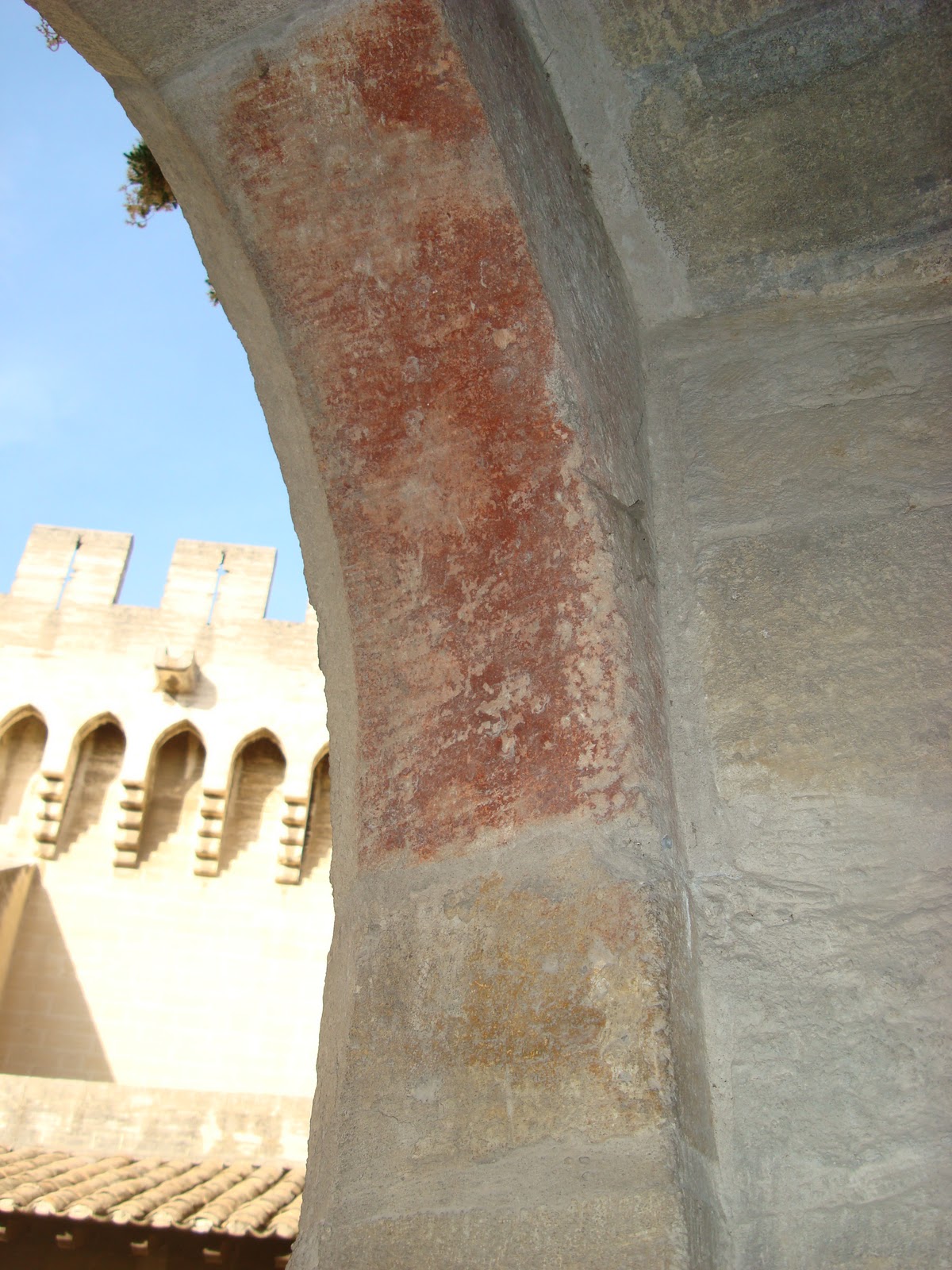
A hefty portion of the papal funds, which I am pretty certain could have been used for more productive things than building a palace (unless they are building it to glorify God - then I suppose we can't really fault them because that would be something like finding fault in or dishonoring God, and that's a no-no), went to building this gargantuan house under Popes Benedict XII, Clément VI, Innocent VI, and Urban V. Clément VI and Innocent VI contributed significantly to the expansion of the palace while Urban V pretty much put the finishing touches on the whole building. Finishing touches such as ceramic floor tiles, fantastic frescoes that adorned the walls and ceilings, and basically lots and lots of color. During the papal occupation, this place would have been more colorful than a rainbow on acid. Unfortunately, all that is left of that magnificent color today are a few tiles and faded, crumbling frescoes and painted walls.


Basically, this place was pretty darn impressive (nothing to Saint Peter's in Rome, I'm sure, but still - not bad) with its grand dining halls and large stained glass windows and Gothic ribbed vaults.

The second place of interest is not far from the papal palace and is nowhere near as magnificent, and yet somehow still as spectacular. It is a bridge: the Pont Saint-Bénezet. This medieval bridge once spanned the Rhône, connecting the city to Villeneuve-lès-Avignon, but suffered from what can essentially be boiled down to bad construction and collapsed several times over the following centuries. It was rebuilt and rebuilt until finally they decided to stop preventing what fate had clearly been telling them for years was meant to be in 1668 when the bridge was virtually washed away by a flood. Today, the vestiges of this once-jinxed bridge are a major tourist destination for people in Avignon, and it's no wonder why. Just look at the views you can get from the bridge:
I wonder if people in the Middle Ages ever stopped to appreciate this same view? Well, minus the sidewalk...
I wonder if the Avignon popes ever admired the view from here? Well, minus the cars...
The bridge itself is pretty cool as well since it just ends in the middle of the river, leaving the uninformed tourist more than just a little curious as to the history behind the ruins.
See that patch of trees just beyond the bridge? That is where the rest of the bridge SHOULD be.
The rest of Avignon didn't strike me as much more than a typical, small French city. That said, I was there for less than a day, so I really wasn't able to take much of the city in, and I enjoyed what I was able to see... but at the end of the day, I was looking forward to reaching my final destination of Arles.

Arles


For someone such as me who loves classical civilizations, Arles is a must-see city. While it is small enough that it can be walked in less than a day and completely exhausted of its treasures in two to three days, it has enough charm and history attached to it to make it worth any weekend getaway, especially when one is in the mood for a small French town.

I first visited Arles as part of an international student tour group and spent a grand total of two, maybe three hours there before being carted off to my next destination. And so I had had it in my mind to make a trip up to Arles at some point during my travels within France. The Toussaint vacation seemed to be the perfect time, so off I went to discover the ancient Roman ruins and the old haunts of everyone's favorite ear-cutting Impressionist.

Like many French cities that have any history at all (read: all of them, duh), Arles is a strange mix of styles and centuries. You can walk along the Rhône and run across the ancient Roman baths built by Constantine, who was a huge fan of the Roman colony, which as far as I can tell went by the name of Arlate back in the day. Then, you can turn to your left and see some nifty modern graffiti on the side of a low wall hiding a dumpster. Walk a little further down and you can spot a ruined wall left over from what might have been an attack during a world war. And let us not forget Les Alyscamps across town, comprised of an ancient Roman necropolis and a medieval Christian church.
Exterior shot of the Thermes de Constantin
Interior shot
"Insure yourself against chance. One look comes so quickly."
The black and white was too irresistible of an option to pass up for this shot.
I have a thing for empty sepulchers and abandoned churches
Arles is a haven for history buffs. Its streets and far corners are laden with centuries upon centuries of rich European history and it is impossible to navigate the narrow streets without chancing upon yet another story pertaining to Arles's 2800 or so years of existence.

My favorite sites, though, focused on the Roman vestiges and the scenic reminders of Van Gogh's beautifully colored French village. The antiquities museum on the outskirts of "centre ville" is well worth the trip for an in-depth look at the development of the city, with plenty of artifacts to sate one's appetite for Roman sculpture, Early Christian iconography, and pottery galore. While I was there, it just so happened that special exhibition centered around an archeological dig done at the bottom of the Rhône not far from Arles. The city had been a major mercantile mecca for people from all over Europe, and as a result, researchers found remains of various types of amphorae and other types of pottery whose names are escaping me at the moment from countries all over the Mediterranean. Since I vaguely understand the importance of such archeological treasures, I had fun comparing the minute differences (and the glaringly obvious ones, as well) between amphorae from select countries and even across continents.

I was even able to study for a midterm while at this museum. My medieval archeology class from last semester focused on Late Antiquity and the early Middle Ages, which is when France was subjected to a widespread Christianization of cities and rural areas. Sarcophagi dating from this period are the perfect visual aides for understanding early Christian iconography and the general transition to a monotheistic society.

And then, the ancient theater and arena. Which are best discussed in picture form.
See those columns? Now imagine that the set was twice as high. Oh, yeah. Theater geek's wet dream. Or nightmare.
It's almost like a graveyard. Which pleases my inner creepiness.
This colosseum is still used today
View of Arles from the top of the tower
Oh, and let's not forget our dearly beloved friend Van Gogh!!!!
L'Espace Van Gogh: the hospital where Van Gogh once lived
I made friends with the waiter my first day in Arles. He invited me back to the restaurant the next day, so I returned with the friends I had met in my hostel. Hope he appreciated the business.

Saturday, December 11, 2010

A Quick One While I'm Away

Hello friends!

So, good news and bad news.

GOOD NEWS: I'm updating!!! Huzzah!

BAD NEWS: This is a really short update.

I have been really, really, magnificently behind schedule on updating because I've been really, really, magnificently busy as of late. I think it finally trickled through my skull that I am still a university student, and now that classes are nearing their end, I have suddenly realized that, oh, crap, I have a lot of work to do. And, of course, since I am a perfectionist at heart, it has to be as perfect as my current level of French will allow.

Alrighty, but enough excuses. Let me update you on the essentials. Some travelling has been done. I went to Monaco to represent Wellesley at a presentation about attending college in the United States. Monaco is fantastic, really expensive, and full of never-ending hills. There are so many uphill climbs, in fact, that Monaco installed public elevators for people to get around. No friggin' joke.
Why did they think it would be a good idea to put a city on the side of a mountain?
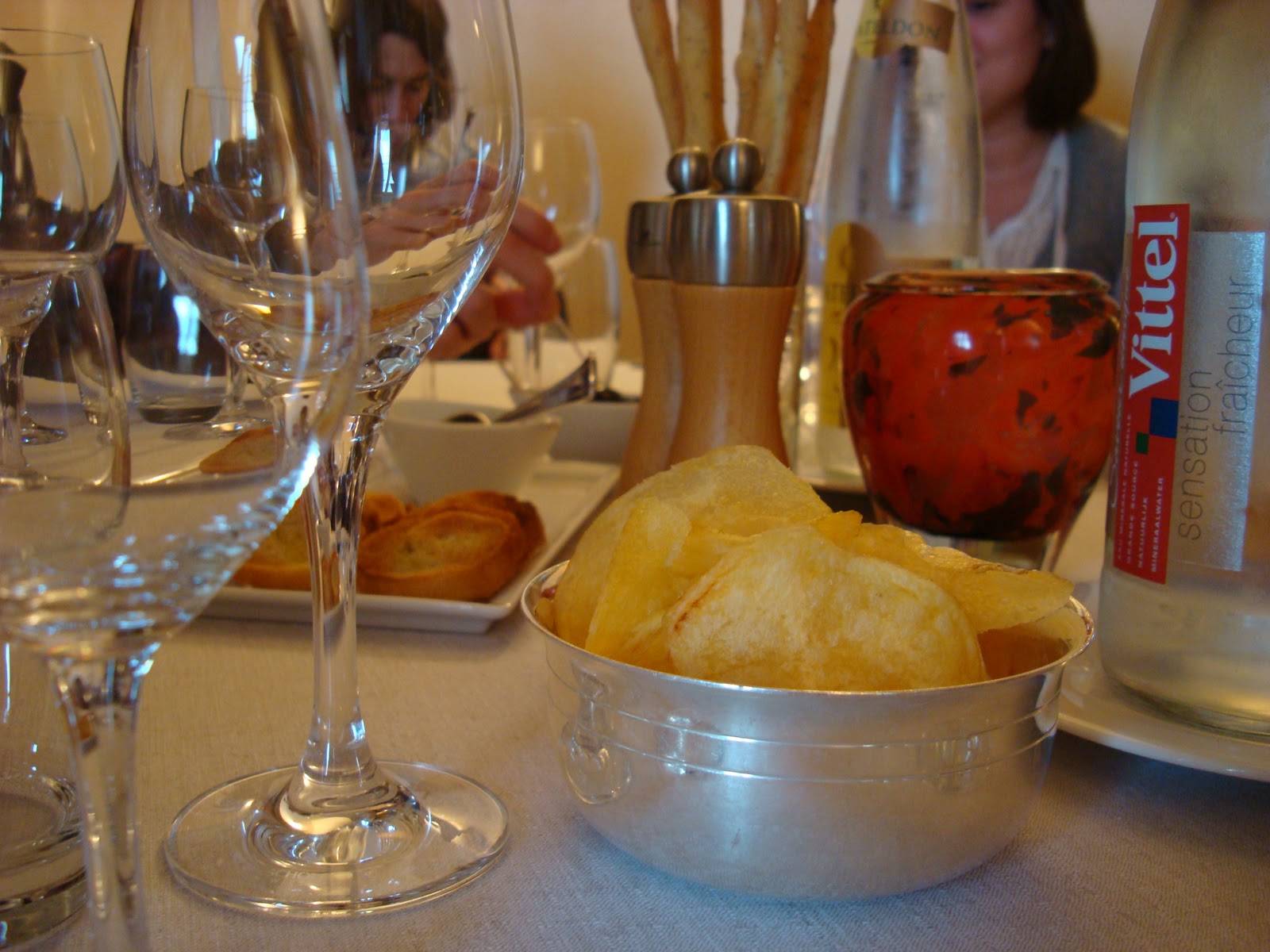
And then, with the Wellesley-in-Aix peeps, I got to see a good bit of the Luberon, which is gorgeous. We drove through Bonnieux, which a lovely hillside village across the valley from the former residence of the Marquis de Sade, ate lunch in Gordes at a five star hotel and restaurant, took a brisk walk through Roussillon, which is one of the most astounding locations in the world, and were privy to a guided tour of the Abbaye de Sénanque, which you might know for being that old-looking abbey with the fields upon fields of lavender surrounding it.
The rooftops of Bonnieux
Potato chips: Gourmet food for visitors of Gordes
Purdy flowers (and my shockingly blue glove) in Roussillon
One of the first good glimpses of the Abbaye de Sénanque
Otherwise, I've been living in Aix, enjoying the company of friends. We've had parties and dinners and movie nights and various activities all throughout Aix just about every weekend, and it's been great! It's fun to see such a mix of Americans, French, Australians, Germans, and so on! One of my favorite activities of late was the "Festival Tous Courts," the annual international short film festival in Aix-en-Provence. My friend Cédric and I went to see the winners of the festival. In all, we saw eight (possibly nine... I might have forgotten one when reviewing them) films, and my favorite was probably "J'attends une femme," an imparting of wisdom from mother to daughter as the mother reaches the end of her pregnancy. The mother shares stories, brutally honest facts and opinions, general advice, and often humorous anecdotes of what it will be like to be born and to grow and to learn and to live as a woman.

Since we are now in the month of December, it is very clearly Christmas season. And France definitely knows  how to celebrate this fact. On Cours Mirabeau, they've got a daily Christmas market with hand-crafted items, cute little souvenirs and knick-knacks, specialties of the region or season (calissons, vin chaud, churros, pretzels, etc.), and a second merry-go-round specifically for the season. Pretty darn cool. I got some Christmas shopping done there, and indulged myself a little bit by purchasing a real, hand-painted Venetian mask. Now, I absolutely have no reason whatsoever to NOT go to Venice, especially since one of my vacations in the spring semester happens to fall on the same dates of the Carnivale de Venezia. So ridiculously excited for Venice.

I'm also excited for spending Christmas in Paris. Everything is settled on that account, which is comforting. This is the first Christmas that I can think of that will be spent away from home, which is particularly upsetting since I have not been home in so long, but I try to not let it get me down too much because, hey, I am spending Christmas in Paris. This is something that I have been dreaming of doing for years, and considering the fact that Paris has been getting a lot of snow recently, it looks like I might even be able to have an actual white Christmas in Paris. How lovely!

Well, I can hear the piles of homework calling, so I think I had better tend to them before they start screaming at me. I promise to continue with the entries about the various cities I've visited, and to tell you all about my holidays once I get through exams.

Peace, love, and chestnuts roasting on an open fire,
Rachel

Friday, November 5, 2010

Postcards from Tiny Towns, Part 1

I have been fortunate enough ever since my arrival in Aix-en-Provence to do a little travelling around the region, both with groups of international students and on my own. As a result, I have seen some absolutely breathtaking sights and have officially decided that France is my third home... after San Diego and Boston, of course. This entry is going to be, essentially, a two-parter. This first part is going to be dedicated to the various tiny tours I passed though and visited throughout my journeys. The second part will chronicle larger towns where I might or might not have spent a little more time, depending on the situation. From the beginning!

Saintes-Maries-de-la-Mer


I came to this small city during a tour of three different, but culturally prominent, cities in Provence with other international students. I spent all of two hours here, but I had fun nevertheless and am of the mind that anywhere with a beach is a fabulous place to live.
Nevermind that this is a continent and an ocean away from San Diego - this felt like home.
While there, I stopped by the église des Saintes Maries, which is now a pilgrimage destination for Roma who gather yearly in this town to celebrate Saint Sarah. She receives even more attention than the three Marys for whom the town is named, and, to top it all off, Sarah was supposedly the dark-skinned Egyptian servant of the three Marys in one account, a charitable Gypsy woman in another, and the daughter of Jesus and Mary Magdalene in a third. Anyway you look at it, she must have had a pretty interesting life, and at one point definitely appeared to have lived in the Camargue, the marshy delta of the Rhône.
Pictured: One mysterious woman
Eventually, she was adopted as the saint of the Roma, and now people from far and wide come to visit her shrine Saintes-Maries-de-la-Mer, where she supposedly lived with the Three Marys.
Gratuitous photo of votive candles
This place becomes more interesting the more I read about it. Supposedly, it has a population of about 2500 (so, roughly one very overstuffed Wellesley College) that swells to 50,000 during the summer holidays. In other words, the population is twenty times as large in the summer. That is like turning Wellesley into two UCSD campuses. Where do they put these 48,000 people, I wonder? Does everyone and their brother have a nice summer cottage in SMDLM where they escape to in the month of August? The main industry is, not surprisingly, tourism, with agriculture coming in a secure second thanks to the surrounding Camargue, so I assume everyone must lie around on the beach in the summer and write postcards to all the suckers stuck at home while thanking Saint Sarah for being awesome.
Haha, suckaaahhhhs!!!


Les Baux-de-Provence


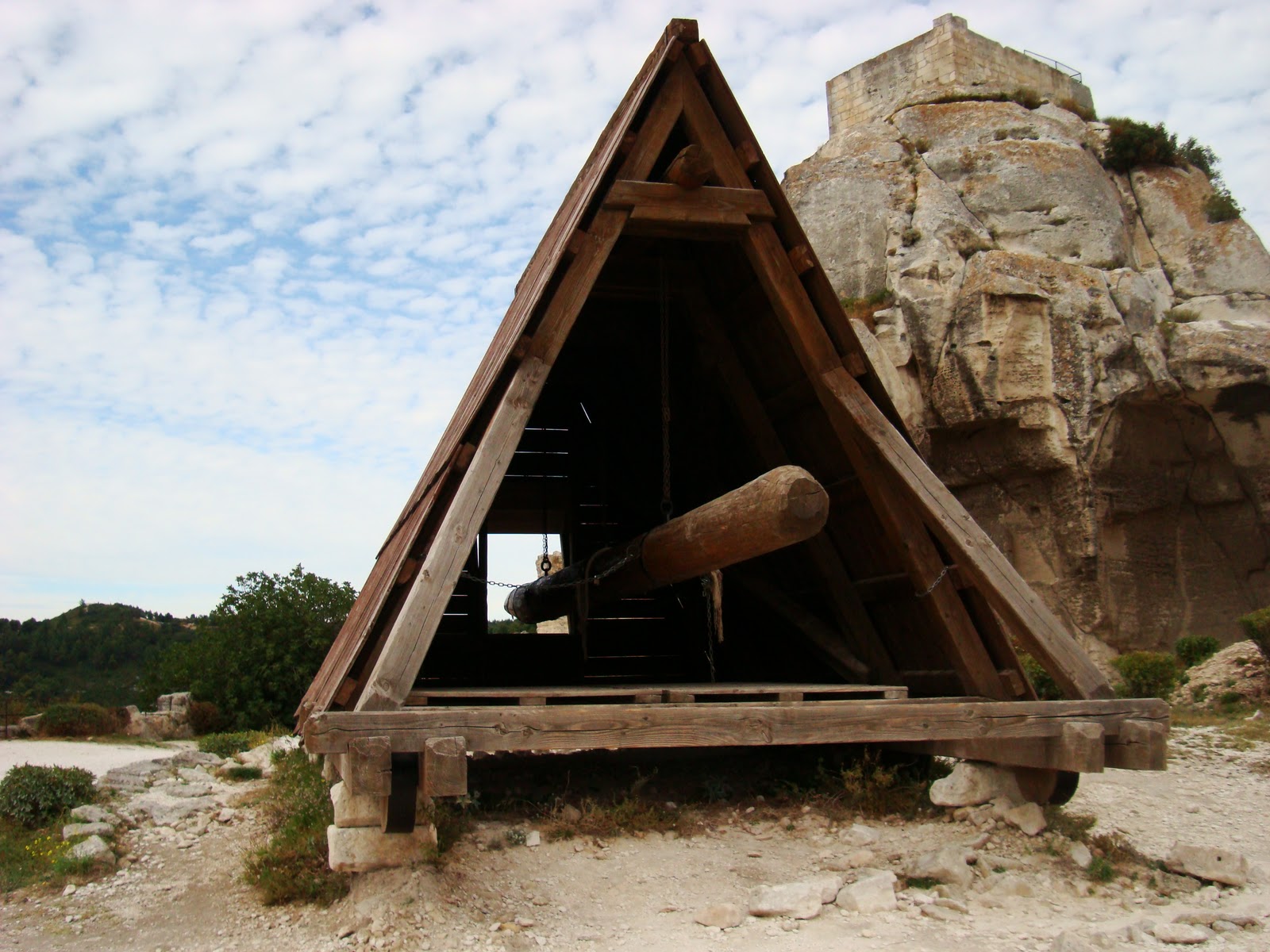
Which is more impressive:

the battering ram

the catapults

or the castle ruins of this commune tucked away in the mountains of the Bouches-du-Rhône department in Provence?

Well, consider this: The lords of Baux were powerful medieval feudal lords who spent years vying for control of Provence. Even once they had been deposed in the 12th century, the court at the Château des Baux-de-Provence continued to be famous for its culture and chivalry. In 1632, its Protestant owners led an unsuccessful revolt against the very Catholic crown, and Cardinal Richelieu, better known as Tim Curry, ordered that the place be dismantled. What you see there today is a result of that dismantling.

These days, nothing as badass as having the wrath of Tim Curry rain down upon you happens in Les Baux, but there are plenty of tourist shops and a multitude of olive groves in the valley below that render the commune one of the most picturesque towns ever.
And with some of the best tapenade around
Oh, and they have catapult reenactments every day in the summer.

My memories of this town are mostly a blur of tiny winding streets uphill and a series of highly eloquent comments such as "whoa" and "awesome" that I traded with my friend Clare as we climbed the heights of the castle. I certainly didn't see any catapult reenactments. But as I looked out over what should really be considered a village hidden away in the mountains, I found myself wondering, and not for the first time since August 21, what it might be like to set up residence in a small city in France. Sure, it may depend on tourism and olives for its business, but Les Baux is still gorgeous and old and people lower down from the summit had outdoor swimming pools, and dammit, now I don't know where in France I'd like to have my summer home.

Cassis

When I think of Cassis, I think of two things, rocky beaches and Milka cows.
And with good reason.
Another French commune, Cassis is known mostly for its cliffs and the "calanques," or sheltered inlets, that run between there and Marseille, which is just a bit to the west.

I visited this village with the other students in my program as part of an organized weekend excursion that WIA puts together every now and again so that we don't forget how freakishly pretty France is.
As if we needed reminding.
Upon our arrival in Cassis, we were taken on a boat tour of the calanques, which lasted about an hour or so, and had to be one of the most amusing boat rides in the world. Being the impressionable, eager 20 years old that we all are, as soon as we stepped foot onto the tour boat, we raced to the seating up front, as close to the bow as possible. After all, what is a trip around the Mediterranean coast if you can't have a good view? The ride started out smoothly enough as we edge out around the lighthouse ("le phare") and out of the bay into the Mediterranean proper. But this was when the wind, which had been whipping out steadily since our arrival, came into play like Nymphadora Tonks in a Swarovski boutique - that is to say, in a rather ungraceful manner.

The wind, of course, helped to make the water of the sea choppier than usual, and the little boat that we were on was truly doing its best to not submerge us all in the chilly saltwater. So, predictably, we were all frequently sprayed with sea water every time the boat dipped over a wave. This meant that I was having the time of my life, grinning gleefully from ear to ear, giggling joyously at each new splash of water, even when one or two managed to catch me off guard and send little drops of water down my shirt. Some of us on the trip were less than completely satisfied with the cold water splashing down on us, but they rallied their spirits and made the best of the situation. Which really wasn't hard to do because all one had to do was look five feet in front of their nose and forget that anything else existed.
Summer Home 1 of 26 in France
The calanques, with their calmer waters, fantastically white and rocky cliffs, and impressive hiking paths, made for an excellent welcome to the tiny city. And the water itself!

Never have I seen water so blue, so clear, so pristine in my life! One could look down and see the blue, iridescent fish swimming alongside the boat. Snorkeling, in warmer months, would actually be an a sightseeing adventure, and not a test of one's eyesight in low light. The last time I had seen water than even approached this clarity was when I was fifteen and went snorkeling for a day a ways off the coast of Mexico near this rocky mound that jutted out of the ocean. Even that couldn't quite live up to this, though, and this was right off shore! So, of course, I had to go swimming.
Why can't all water look like this?
Fast-forward half an hour later, after examining the logistics of changing into one's bathing suit at a French beach where bare breasts are alright, but baring all in front of people I have to live with and see on a regular basis is mortifying at best. I dipped my feet into the water. A tad chilly, but totally doable, I told myself, and at a friend's urging, fully submerged my body in the water.

Bad idea. I began to gasp for the air that jettisoned itself from my lungs upon the realization of just how cold the water really was and scurried back out to the edge of the water where I could sit and let the water wash over me and slowly acclimate me to my new, wet surroundings. Finally, I swam out to join my friends and discovered a whole new level of buoyancy. I don't think I had ever floated so effortlessly in my life - I could literally just sit in the water and do no work whatsoever and remain afloat. It was fantastic, even if on the chilly side.
These rocks have no idea how good they've got things
Some time later, after I had laid out in the sun for a bit and dried off and changed back into appropriate attire and had my fill of some delicious gelato, a significantly sized group of us noticed a man dressed in a purple cow suit some meters down the beach from where we were resting.

Enter the Milka cow.
Is that useful for saving lives or are you just happy to see me?
They were filming a commercial of the Milka cow and a attractive man in a matching purple Speedo running down the beach together Baywatch style. In French.

Day = made.

Tootles for now. Peace, love, and purple cows!

--Rachel