Tuesday, March 8, 2011

It's About Damn Time: Old Ruins, New Sights

Part 2 of 2 concerning Provençal cities, towns, and villages... Let's get the ball rolling in not-quite-alphabetical order.

Avignon

For "les vacanes de Toussaint" (the vacation surrounding All Saint's Day in France), I decided that I would return to a small city along the Rhône called Arles to visit all of the tourist spots I did not have the chance to see the first time around. I knew that there were buses that went there, but I had no idea which buses they were, so I conducted a little research and came to the conclusion that the best way (read: cheapest) to get to Arles via bus was to go up to Avignon first and then catch a bus down and over to Arles -- a little out of the way, sure, but it was not so out of the way as to completely inconvenience the traveler. (I later found out that there is a direct bus from Aix to Arles, but, alas, I learned this vital piece of information too late.)

This was really not a problem for me. I was delighted to have the opportunity to see another Provençal city and get a little more history out of the trip than I had originally planned.

Enter Avignon.
Literally a row of restaurants on the Place de l'Horloge
Yet another small town in the south of France that has been around forever, Avignon is particularly well-known for its Palais des Papes, which is by no means a misnomer. During the 14th century, a series of popes took up residence in Avignon, wishing to avoid the violence and political instability in Rome, and as such, were drawn further and further under the influence of the French crown. Which, you know, makes sense considering that all seven popes who lived in Avignon were, uh... French.

So, Clement V took up residence in Avignon in 1309, and since Avignon was clearly not the religious center that Rome was (is, if we're including the Vatican City in Rome), they didn't have a papal palace yet, meaning that Clement V was humble enough to pass the time in a Dominican monastery. His successor, however, began reconstructing a nearby bishop's palace by turning it into something that really makes one question the whole "vow of poverty" thing that members of the clergy live by.
It's not mine; I just live here and reap the glorious benefits
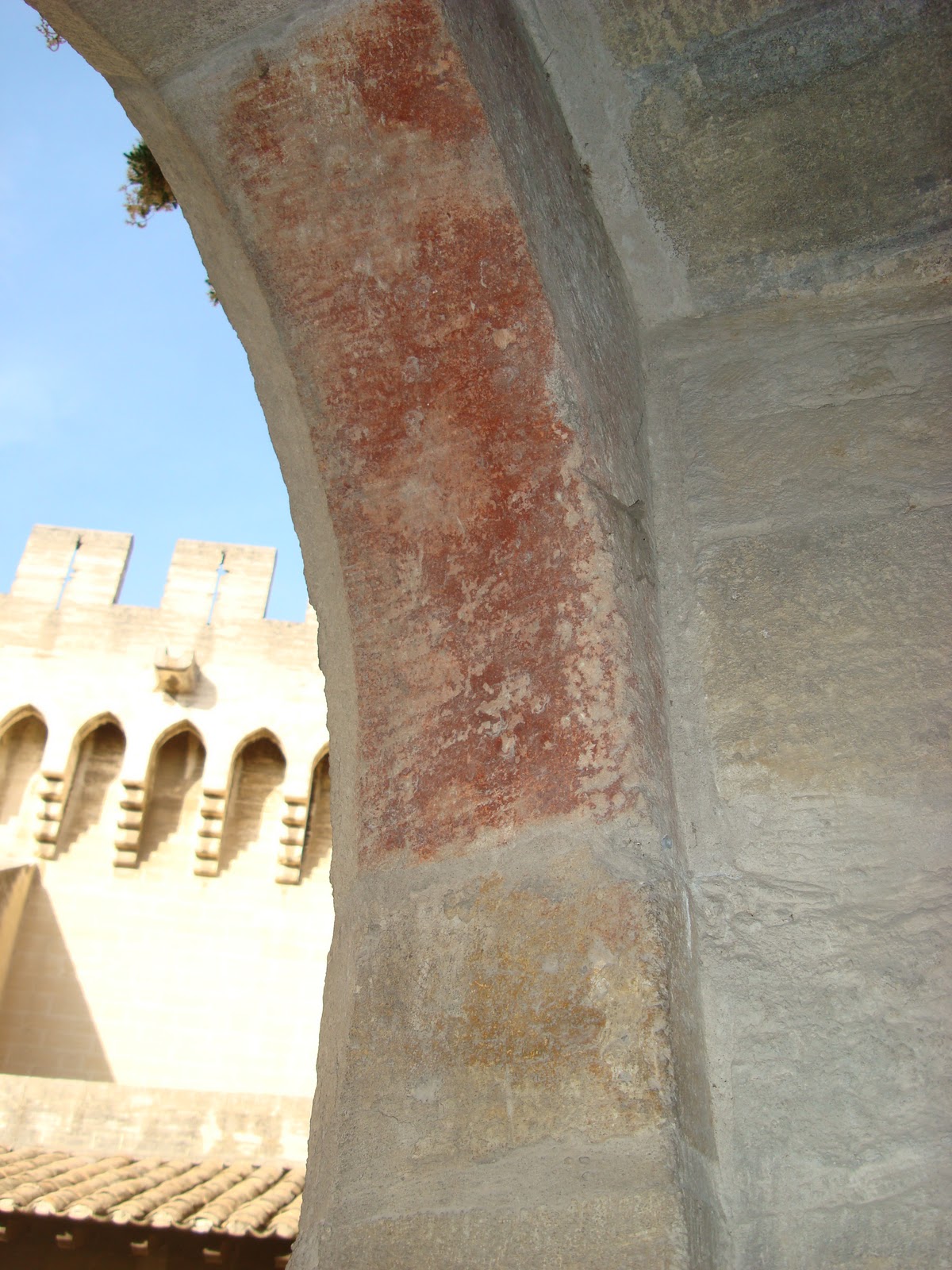
A hefty portion of the papal funds, which I am pretty certain could have been used for more productive things than building a palace (unless they are building it to glorify God - then I suppose we can't really fault them because that would be something like finding fault in or dishonoring God, and that's a no-no), went to building this gargantuan house under Popes Benedict XII, Clément VI, Innocent VI, and Urban V. Clément VI and Innocent VI contributed significantly to the expansion of the palace while Urban V pretty much put the finishing touches on the whole building. Finishing touches such as ceramic floor tiles, fantastic frescoes that adorned the walls and ceilings, and basically lots and lots of color. During the papal occupation, this place would have been more colorful than a rainbow on acid. Unfortunately, all that is left of that magnificent color today are a few tiles and faded, crumbling frescoes and painted walls.


Basically, this place was pretty darn impressive (nothing to Saint Peter's in Rome, I'm sure, but still - not bad) with its grand dining halls and large stained glass windows and Gothic ribbed vaults.

The second place of interest is not far from the papal palace and is nowhere near as magnificent, and yet somehow still as spectacular. It is a bridge: the Pont Saint-Bénezet. This medieval bridge once spanned the Rhône, connecting the city to Villeneuve-lès-Avignon, but suffered from what can essentially be boiled down to bad construction and collapsed several times over the following centuries. It was rebuilt and rebuilt until finally they decided to stop preventing what fate had clearly been telling them for years was meant to be in 1668 when the bridge was virtually washed away by a flood. Today, the vestiges of this once-jinxed bridge are a major tourist destination for people in Avignon, and it's no wonder why. Just look at the views you can get from the bridge:
I wonder if people in the Middle Ages ever stopped to appreciate this same view? Well, minus the sidewalk...
I wonder if the Avignon popes ever admired the view from here? Well, minus the cars...
The bridge itself is pretty cool as well since it just ends in the middle of the river, leaving the uninformed tourist more than just a little curious as to the history behind the ruins.
See that patch of trees just beyond the bridge? That is where the rest of the bridge SHOULD be.
The rest of Avignon didn't strike me as much more than a typical, small French city. That said, I was there for less than a day, so I really wasn't able to take much of the city in, and I enjoyed what I was able to see... but at the end of the day, I was looking forward to reaching my final destination of Arles.

Arles


For someone such as me who loves classical civilizations, Arles is a must-see city. While it is small enough that it can be walked in less than a day and completely exhausted of its treasures in two to three days, it has enough charm and history attached to it to make it worth any weekend getaway, especially when one is in the mood for a small French town.

I first visited Arles as part of an international student tour group and spent a grand total of two, maybe three hours there before being carted off to my next destination. And so I had had it in my mind to make a trip up to Arles at some point during my travels within France. The Toussaint vacation seemed to be the perfect time, so off I went to discover the ancient Roman ruins and the old haunts of everyone's favorite ear-cutting Impressionist.

Like many French cities that have any history at all (read: all of them, duh), Arles is a strange mix of styles and centuries. You can walk along the Rhône and run across the ancient Roman baths built by Constantine, who was a huge fan of the Roman colony, which as far as I can tell went by the name of Arlate back in the day. Then, you can turn to your left and see some nifty modern graffiti on the side of a low wall hiding a dumpster. Walk a little further down and you can spot a ruined wall left over from what might have been an attack during a world war. And let us not forget Les Alyscamps across town, comprised of an ancient Roman necropolis and a medieval Christian church.
Exterior shot of the Thermes de Constantin
Interior shot
"Insure yourself against chance. One look comes so quickly."
The black and white was too irresistible of an option to pass up for this shot.
I have a thing for empty sepulchers and abandoned churches
Arles is a haven for history buffs. Its streets and far corners are laden with centuries upon centuries of rich European history and it is impossible to navigate the narrow streets without chancing upon yet another story pertaining to Arles's 2800 or so years of existence.

My favorite sites, though, focused on the Roman vestiges and the scenic reminders of Van Gogh's beautifully colored French village. The antiquities museum on the outskirts of "centre ville" is well worth the trip for an in-depth look at the development of the city, with plenty of artifacts to sate one's appetite for Roman sculpture, Early Christian iconography, and pottery galore. While I was there, it just so happened that special exhibition centered around an archeological dig done at the bottom of the Rhône not far from Arles. The city had been a major mercantile mecca for people from all over Europe, and as a result, researchers found remains of various types of amphorae and other types of pottery whose names are escaping me at the moment from countries all over the Mediterranean. Since I vaguely understand the importance of such archeological treasures, I had fun comparing the minute differences (and the glaringly obvious ones, as well) between amphorae from select countries and even across continents.

I was even able to study for a midterm while at this museum. My medieval archeology class from last semester focused on Late Antiquity and the early Middle Ages, which is when France was subjected to a widespread Christianization of cities and rural areas. Sarcophagi dating from this period are the perfect visual aides for understanding early Christian iconography and the general transition to a monotheistic society.

And then, the ancient theater and arena. Which are best discussed in picture form.
See those columns? Now imagine that the set was twice as high. Oh, yeah. Theater geek's wet dream. Or nightmare.
It's almost like a graveyard. Which pleases my inner creepiness.
This colosseum is still used today
View of Arles from the top of the tower
Oh, and let's not forget our dearly beloved friend Van Gogh!!!!
L'Espace Van Gogh: the hospital where Van Gogh once lived
I made friends with the waiter my first day in Arles. He invited me back to the restaurant the next day, so I returned with the friends I had met in my hostel. Hope he appreciated the business.

Saturday, December 11, 2010

A Quick One While I'm Away

Hello friends!

So, good news and bad news.

GOOD NEWS: I'm updating!!! Huzzah!

BAD NEWS: This is a really short update.

I have been really, really, magnificently behind schedule on updating because I've been really, really, magnificently busy as of late. I think it finally trickled through my skull that I am still a university student, and now that classes are nearing their end, I have suddenly realized that, oh, crap, I have a lot of work to do. And, of course, since I am a perfectionist at heart, it has to be as perfect as my current level of French will allow.

Alrighty, but enough excuses. Let me update you on the essentials. Some travelling has been done. I went to Monaco to represent Wellesley at a presentation about attending college in the United States. Monaco is fantastic, really expensive, and full of never-ending hills. There are so many uphill climbs, in fact, that Monaco installed public elevators for people to get around. No friggin' joke.
Why did they think it would be a good idea to put a city on the side of a mountain?
And then, with the Wellesley-in-Aix peeps, I got to see a good bit of the Luberon, which is gorgeous. We drove through Bonnieux, which a lovely hillside village across the valley from the former residence of the Marquis de Sade, ate lunch in Gordes at a five star hotel and restaurant, took a brisk walk through Roussillon, which is one of the most astounding locations in the world, and were privy to a guided tour of the Abbaye de Sénanque, which you might know for being that old-looking abbey with the fields upon fields of lavender surrounding it.
The rooftops of Bonnieux
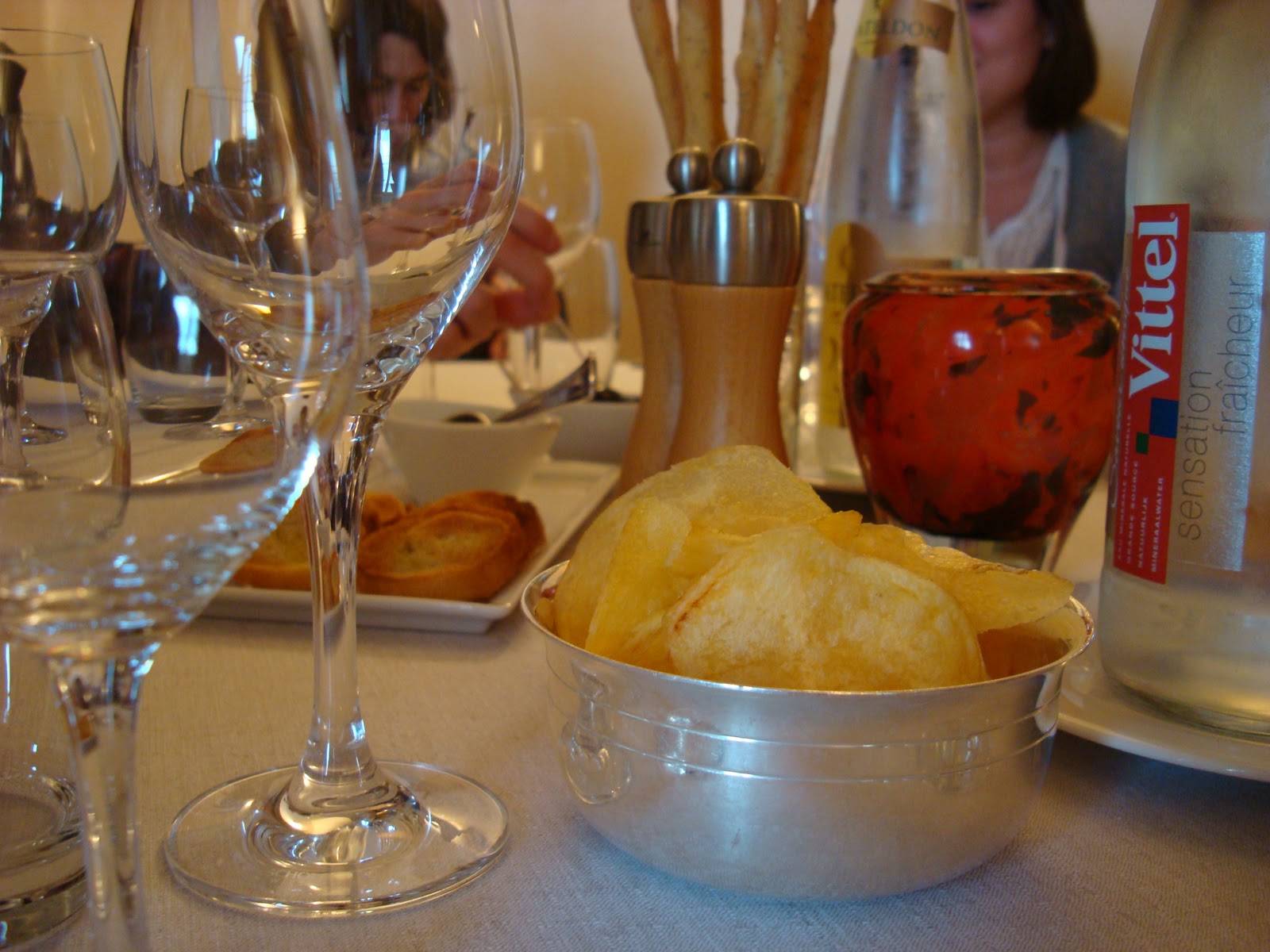
Potato chips: Gourmet food for visitors of Gordes
Purdy flowers (and my shockingly blue glove) in Roussillon
One of the first good glimpses of the Abbaye de Sénanque
Otherwise, I've been living in Aix, enjoying the company of friends. We've had parties and dinners and movie nights and various activities all throughout Aix just about every weekend, and it's been great! It's fun to see such a mix of Americans, French, Australians, Germans, and so on! One of my favorite activities of late was the "Festival Tous Courts," the annual international short film festival in Aix-en-Provence. My friend Cédric and I went to see the winners of the festival. In all, we saw eight (possibly nine... I might have forgotten one when reviewing them) films, and my favorite was probably "J'attends une femme," an imparting of wisdom from mother to daughter as the mother reaches the end of her pregnancy. The mother shares stories, brutally honest facts and opinions, general advice, and often humorous anecdotes of what it will be like to be born and to grow and to learn and to live as a woman.

Since we are now in the month of December, it is very clearly Christmas season. And France definitely knows  how to celebrate this fact. On Cours Mirabeau, they've got a daily Christmas market with hand-crafted items, cute little souvenirs and knick-knacks, specialties of the region or season (calissons, vin chaud, churros, pretzels, etc.), and a second merry-go-round specifically for the season. Pretty darn cool. I got some Christmas shopping done there, and indulged myself a little bit by purchasing a real, hand-painted Venetian mask. Now, I absolutely have no reason whatsoever to NOT go to Venice, especially since one of my vacations in the spring semester happens to fall on the same dates of the Carnivale de Venezia. So ridiculously excited for Venice.

I'm also excited for spending Christmas in Paris. Everything is settled on that account, which is comforting. This is the first Christmas that I can think of that will be spent away from home, which is particularly upsetting since I have not been home in so long, but I try to not let it get me down too much because, hey, I am spending Christmas in Paris. This is something that I have been dreaming of doing for years, and considering the fact that Paris has been getting a lot of snow recently, it looks like I might even be able to have an actual white Christmas in Paris. How lovely!

Well, I can hear the piles of homework calling, so I think I had better tend to them before they start screaming at me. I promise to continue with the entries about the various cities I've visited, and to tell you all about my holidays once I get through exams.

Peace, love, and chestnuts roasting on an open fire,
Rachel

Friday, November 5, 2010

Postcards from Tiny Towns, Part 1

I have been fortunate enough ever since my arrival in Aix-en-Provence to do a little travelling around the region, both with groups of international students and on my own. As a result, I have seen some absolutely breathtaking sights and have officially decided that France is my third home... after San Diego and Boston, of course. This entry is going to be, essentially, a two-parter. This first part is going to be dedicated to the various tiny tours I passed though and visited throughout my journeys. The second part will chronicle larger towns where I might or might not have spent a little more time, depending on the situation. From the beginning!

Saintes-Maries-de-la-Mer


I came to this small city during a tour of three different, but culturally prominent, cities in Provence with other international students. I spent all of two hours here, but I had fun nevertheless and am of the mind that anywhere with a beach is a fabulous place to live.
Nevermind that this is a continent and an ocean away from San Diego - this felt like home.
While there, I stopped by the église des Saintes Maries, which is now a pilgrimage destination for Roma who gather yearly in this town to celebrate Saint Sarah. She receives even more attention than the three Marys for whom the town is named, and, to top it all off, Sarah was supposedly the dark-skinned Egyptian servant of the three Marys in one account, a charitable Gypsy woman in another, and the daughter of Jesus and Mary Magdalene in a third. Anyway you look at it, she must have had a pretty interesting life, and at one point definitely appeared to have lived in the Camargue, the marshy delta of the Rhône.
Pictured: One mysterious woman
Eventually, she was adopted as the saint of the Roma, and now people from far and wide come to visit her shrine Saintes-Maries-de-la-Mer, where she supposedly lived with the Three Marys.
Gratuitous photo of votive candles
This place becomes more interesting the more I read about it. Supposedly, it has a population of about 2500 (so, roughly one very overstuffed Wellesley College) that swells to 50,000 during the summer holidays. In other words, the population is twenty times as large in the summer. That is like turning Wellesley into two UCSD campuses. Where do they put these 48,000 people, I wonder? Does everyone and their brother have a nice summer cottage in SMDLM where they escape to in the month of August? The main industry is, not surprisingly, tourism, with agriculture coming in a secure second thanks to the surrounding Camargue, so I assume everyone must lie around on the beach in the summer and write postcards to all the suckers stuck at home while thanking Saint Sarah for being awesome.
Haha, suckaaahhhhs!!!


Les Baux-de-Provence


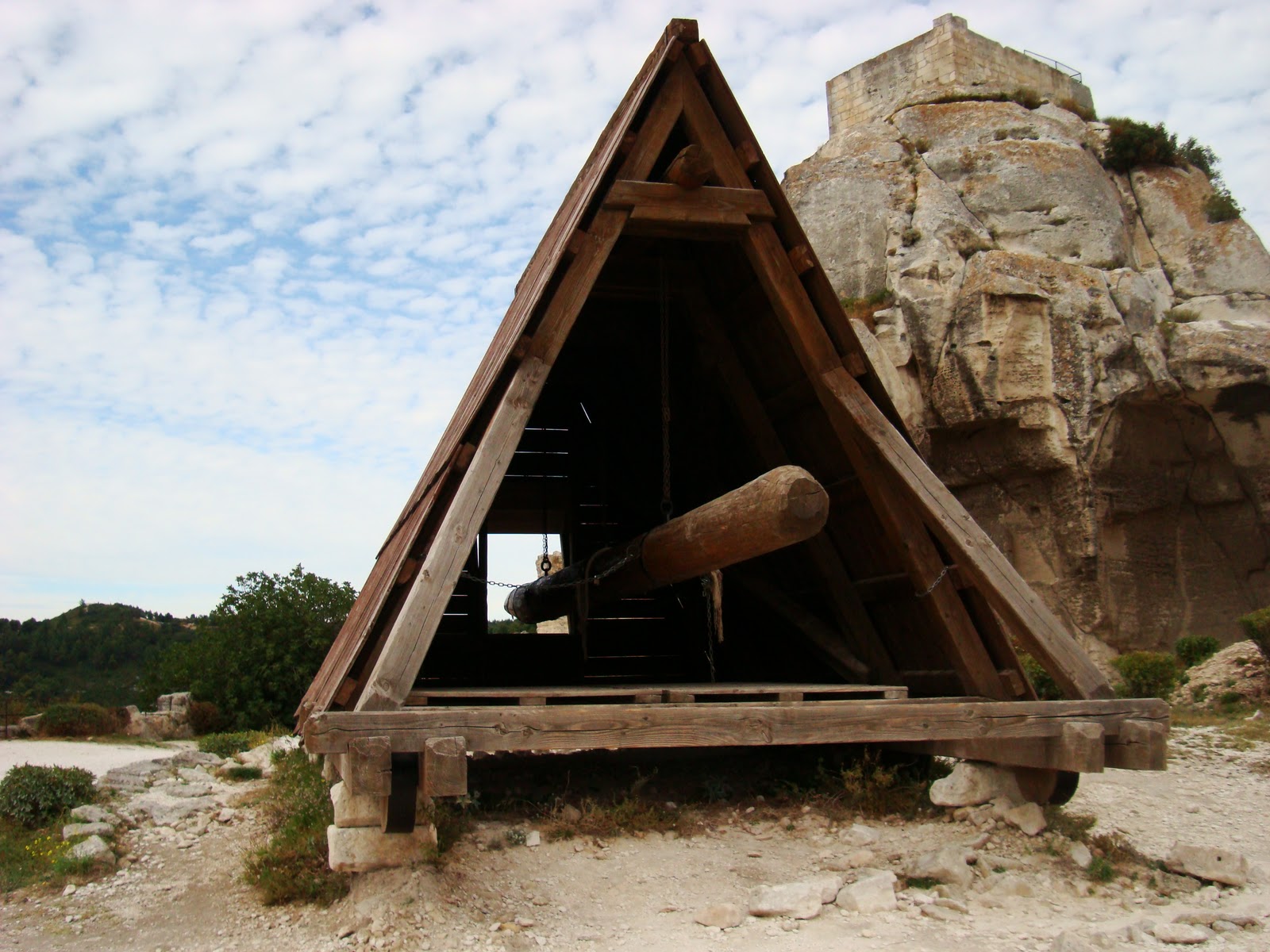
Which is more impressive:

the battering ram

the catapults

or the castle ruins of this commune tucked away in the mountains of the Bouches-du-Rhône department in Provence?

Well, consider this: The lords of Baux were powerful medieval feudal lords who spent years vying for control of Provence. Even once they had been deposed in the 12th century, the court at the Château des Baux-de-Provence continued to be famous for its culture and chivalry. In 1632, its Protestant owners led an unsuccessful revolt against the very Catholic crown, and Cardinal Richelieu, better known as Tim Curry, ordered that the place be dismantled. What you see there today is a result of that dismantling.

These days, nothing as badass as having the wrath of Tim Curry rain down upon you happens in Les Baux, but there are plenty of tourist shops and a multitude of olive groves in the valley below that render the commune one of the most picturesque towns ever.
And with some of the best tapenade around
Oh, and they have catapult reenactments every day in the summer.

My memories of this town are mostly a blur of tiny winding streets uphill and a series of highly eloquent comments such as "whoa" and "awesome" that I traded with my friend Clare as we climbed the heights of the castle. I certainly didn't see any catapult reenactments. But as I looked out over what should really be considered a village hidden away in the mountains, I found myself wondering, and not for the first time since August 21, what it might be like to set up residence in a small city in France. Sure, it may depend on tourism and olives for its business, but Les Baux is still gorgeous and old and people lower down from the summit had outdoor swimming pools, and dammit, now I don't know where in France I'd like to have my summer home.

Cassis

When I think of Cassis, I think of two things, rocky beaches and Milka cows.
And with good reason.
Another French commune, Cassis is known mostly for its cliffs and the "calanques," or sheltered inlets, that run between there and Marseille, which is just a bit to the west.

I visited this village with the other students in my program as part of an organized weekend excursion that WIA puts together every now and again so that we don't forget how freakishly pretty France is.
As if we needed reminding.
Upon our arrival in Cassis, we were taken on a boat tour of the calanques, which lasted about an hour or so, and had to be one of the most amusing boat rides in the world. Being the impressionable, eager 20 years old that we all are, as soon as we stepped foot onto the tour boat, we raced to the seating up front, as close to the bow as possible. After all, what is a trip around the Mediterranean coast if you can't have a good view? The ride started out smoothly enough as we edge out around the lighthouse ("le phare") and out of the bay into the Mediterranean proper. But this was when the wind, which had been whipping out steadily since our arrival, came into play like Nymphadora Tonks in a Swarovski boutique - that is to say, in a rather ungraceful manner.

The wind, of course, helped to make the water of the sea choppier than usual, and the little boat that we were on was truly doing its best to not submerge us all in the chilly saltwater. So, predictably, we were all frequently sprayed with sea water every time the boat dipped over a wave. This meant that I was having the time of my life, grinning gleefully from ear to ear, giggling joyously at each new splash of water, even when one or two managed to catch me off guard and send little drops of water down my shirt. Some of us on the trip were less than completely satisfied with the cold water splashing down on us, but they rallied their spirits and made the best of the situation. Which really wasn't hard to do because all one had to do was look five feet in front of their nose and forget that anything else existed.
Summer Home 1 of 26 in France
The calanques, with their calmer waters, fantastically white and rocky cliffs, and impressive hiking paths, made for an excellent welcome to the tiny city. And the water itself!

Never have I seen water so blue, so clear, so pristine in my life! One could look down and see the blue, iridescent fish swimming alongside the boat. Snorkeling, in warmer months, would actually be an a sightseeing adventure, and not a test of one's eyesight in low light. The last time I had seen water than even approached this clarity was when I was fifteen and went snorkeling for a day a ways off the coast of Mexico near this rocky mound that jutted out of the ocean. Even that couldn't quite live up to this, though, and this was right off shore! So, of course, I had to go swimming.
Why can't all water look like this?
Fast-forward half an hour later, after examining the logistics of changing into one's bathing suit at a French beach where bare breasts are alright, but baring all in front of people I have to live with and see on a regular basis is mortifying at best. I dipped my feet into the water. A tad chilly, but totally doable, I told myself, and at a friend's urging, fully submerged my body in the water.

Bad idea. I began to gasp for the air that jettisoned itself from my lungs upon the realization of just how cold the water really was and scurried back out to the edge of the water where I could sit and let the water wash over me and slowly acclimate me to my new, wet surroundings. Finally, I swam out to join my friends and discovered a whole new level of buoyancy. I don't think I had ever floated so effortlessly in my life - I could literally just sit in the water and do no work whatsoever and remain afloat. It was fantastic, even if on the chilly side.
These rocks have no idea how good they've got things
Some time later, after I had laid out in the sun for a bit and dried off and changed back into appropriate attire and had my fill of some delicious gelato, a significantly sized group of us noticed a man dressed in a purple cow suit some meters down the beach from where we were resting.

Enter the Milka cow.
Is that useful for saving lives or are you just happy to see me?
They were filming a commercial of the Milka cow and a attractive man in a matching purple Speedo running down the beach together Baywatch style. In French.

Day = made.

Tootles for now. Peace, love, and purple cows!

--Rachel

Monday, October 25, 2010

I Suck At Updating

Seriously. I think I am actually assimilating to French culture because I seem to be getting closer and closer to adapting the very laid-back attitude of "Oh, it'll get done eventually." And that is an awful idea to have. I need to be studying, filling out forms for credit transfer, finding out about how we shall be making up the time that we missed in class due to the "grève," getting in touch with the cultural exchange program I signed up for to see how my forms are being processed, and, of course, updating my blog. Oh, and there are a whole other slew of things I have likely forgotten, but they are on the to-do list as well.

Life, though, does seem to be a bit more relaxed here, which is a lovely change from Wellesley, but actually has caused more concern on relief on my behalf because I truly want to do well here. I want to earn good grades that will give me an extra confidence boost for when I go back to the States and have to finish up my pre-med requirements. If I do well here, then I will be on a roll and ready to tackle organic chemistry with all the energy of a French protester. And that, dear readers, would truly be a sight to behold. I honestly could not tell you how effective their strikes, protests, manifestations, and riots are in terms of influencing their government, but they are nothing if not determined to have their voices heard. 

(On a somewhat unrelated to my eventual narrative note: A friend of mine actually posted a really interesting article about why the French strike to her Facebook page, and I think it is very informative. The article can be found here.)

It has officially been two months since I came to France, which is rather surprising when I think about it. It certainly does not feel as though that much time has passed already. I certainly do feel as though I have seen a lot in a somewhat limited period of time, and I definitely get the impression that my French has improved in certain ways over these past two months, but I consider the fact that I have been in France for over 60 days now... well, that seems pretty darn staggering.

Aix-en-Provence is an absolutely gorgeous old town about 30 minutes northeast of Marseille. My apartment building, for example, is a charming unit from the 17th century (assuming I remember correctly... might have been 18th century...), which concretely establishes it as the oldest building in which I have ever lived. And that is not even close to the oldest building here. One of the older (and distinctly more noticeable) buildings here, for example, is the cathedral, which dates from around the 12th century and is one part Romanesque, one part Gothic, and one part Neo-Gothic due to some renovations in the 19th century. 12th century not old enough for you, hardened and world-weary reader? Well, the cathedral gets better. Inside and off to the right in a small alcove are the remnants of a 6th century baptistery, which would not actually have been a part of the former 6th century cathedral but would have been a separate, though adjacent, building to the actual church. I have spent several hours trying to wrap my mind around how friggin' old that really is, and I have discovered this to be nearly unfathomable and thus worthy of my undying admiration.

Yet despite its medieval roots in Christianity, Aix is a highly modern city in its own way. It is, after all, the city with the second highest cost of living in France - just after Paris, of course. Here, you can find an Hermès boutique, a Rolex shop, a Longchamp store... and if those "magasins" just aren't really your style, there is always the H&M which is about 10 minutes walking distance from my apartment. And in addition, there are numerous bars and cafés and restaurants all with outdoor terraces - some of which extend out into the public squares after the morning farmer's markets have been cleared away. And even at some of the cheapest brasseries, the food is still a level above some of the best mid-priced restaurants in the United States. (I will admit, however, that I am still adjusting to French cuisine, so everything here is new and interesting and tasty and French. I might have a different opinion come next May.) It is not uncommon to spend two hours at a restaurant for lunch or for dinner. More than once, I have run across friends sitting outside at such-and-such a café, sipping a tiny French coffee, munching on a croque-monsieur, or studying for class. It is also very common to run into people at establishments such as Wohoo, Sunset Café, or O'Sullivan's, which are known for their *ahem* alcoholic beverages. There are entire streets, in fact, which are practically lined with bars and/or clubs, and bar hopping is almost like a national pastime for French students on an average Thursday evening. Likely due to its high density of ever-changing (international) university students, Aix is a lively town and certainly does not feel like a stifling village that needs to be escaped each weekend via an excursion to Marseille where one can get in touch once again with civilization.

One of my greatest fears in coming to France was being able to communicate with others my age. I worried every day about my ability to understand what they were saying due to 1) my knowledge of "textbook French" and thus total lack of knowledge of French slang and contemporary idioms and 2) the all-too-common tendency for people my age to not only talk at a rather rapid pace, but to hardly enunciate a word that we let loose from our lips. This, coupled with the vestiges of my near-crippling shyness from which I suffered as a mildly awkward and definitely brainy child and my concern over French opinions of American citizens, had me wondering if I would ever effectively communicate with other French students to the point that I could actually call them my friends. Oh, and to top it off, they have Southern French accents.

Yeah, that was really silly of me to worry about.

Turns out, while people aren't exactly clamoring to be your friend, it is actually fairly easy to make friends as long as you actually put forth a little effort. In fact, it is essentially a more advanced, mature version of kindergarten where you walked over to one of the other kids on the monkey bars, introduced yourself and promptly announced that you and your new acquaintance should be friends. Now, though, you meet at a bar/club/café/classroom/party/etc., introduce yourself, talk about your life plans, compare lifestyles in France and the U.S., exchange phone numbers and slowly begin hanging out more and more, inviting each other to parties or movies or a little afternoon snack. You have to be willing to network and to put yourself out there as a foreign student there to speak French and to make the most of the time allotted to you in Aix. And once you do that, the French are very, very friendly. Since one of the first things they learn about you is that you are foreign, they will be happy to speak a little more slowly for you or help you when you are struggling with a word or turn of phrase that you can't quite make work. They also tend to have a lot of questions about life in a foreign country in general.

And my fear of incomprehensible slang? Yeah, well, I hear that now and then when I am out shopping and run across some high schoolers, but not so much in the everyday conversations between myself and a native French speaker. The problems with enunciation happen fairly frequently where they speak a little too quickly or don't articulate with the finesse of a stage actor, but considering that this also happens to me in English (albeit with a greatly reduced frequency) I have learned to not let it bother me too much.

My general comprehension of French has increased since arriving, as well. Even if I cannot understand everything that is said or sung or written, I finally know enough French and can translate in my head rapidly enough that I can catch the general understanding of things. Tiny nuances are still lost on me, but each day I feel as though I am getting closer and closer to my goal of fluency. I can converse easily enough, and my sentence structures and use of grammar and vocabulary are slowly becoming more sophisticated. It is an exciting process overall.

All of my new French friends seem to think that I am quite good at speaking French. They find my accent to be astonishingly non-abrasive and are overall impressed that after six years of learning a foreign language, I can speak with such ease. Hah, they are totally overestimating my abilities, but their kind comments are a welcome ego-boost to this foreigner. Classes are running smoothly, too. My history and art history courses are quite fascinating - I have never learned so much about the Middle Ages in my life. And my translation course is very interesting from a grammatical viewpoint. Learning, learning, learning: there really is something new every day, which makes my inner Hermione Granger jump for joy. Yippee!

My French friends all seem to enjoy going to the cinema as well, which is excellent news for me because, in my opinion, going to see French movies where there are no subtitles and you can't ask anyone to repeat themselves is an excellent test of one's comprehension skills. Last Thursday, I went out to the movies with a few friends, and we saw Les Petits Mouchoirs (English description here), which, I was told, was a classically and typically French film: where the emotions are super intense and nothing much really happens throughout the course of the movie. Those can actually be some of the best movies, though (ref. A Bout de Souffle, arguably Belmondo's best film), and I found the film to be highly enjoyable. It ran a little long at the end, but the balance of comedy and tragedy was appropriate and it gave a fairly accurate depiction of life in France. There were certainly little details I missed through a lack of comprehension, but once I figured out that Guillaume Canet's project (he wrote and directed the film) was basically a French adaptation of The Big Chill, I was able to understand so many more things about the movie. This was simply further evidence that a good portion of anything involving Guillaume Canet will be of quality (excluding The Beach with Leonardo DiCaprio, which many people pretend never happened).

And now, a few pictures to finish up this entry. Enjoy!
Our living room - and my computer Aristophanes
Our lovely kitchen and my roommate's family cookbook
Rue Granet - view from our window
Place d'Albertas
Place de la Rotonde - as seen from les Allées Provençales
Tootles, y'all! Next entry will be about my travels in Provence!

Gros bisous!!
Rachel

Sunday, October 3, 2010

Louis the Lucky Duck

If I lived somewhere with a garden like this
I am certain I would never want to leave. Versailles is worth the visit for this tiny corner of the royal gardens alone. I'm not even including the fountains and the hidden speakers in the walls of shrubbery that play classical music and the perfectly white marble statues and the vividly colored flowers. Heck, I'm not even talking about the parks that extend outside of the initial manicured gardens. I refer merely to what is included in this picture here. I would be content with this for a lifetime.

It boggles the mind to think that this once belonged to a single man. To be fair, he was the leader of an entire nation, but, hey, Obama is the leader of one of the most powerful nations in the world, and he doesn't have a garden like this.

Let's continue with our pretty pictures tour, shall we?
The Royal Gate - Read: the second of two gates leading to the château


The chapel


Strange Japanese statue in front of overly ornate door
The Hall of Mirrors, part 1
The Hall of Mirrors, part 2
I spent a fair amount of time being herded through room after room after room of absolute magnificence by the crowds of people.

Originally, I had planned upon heading out to Versailles early that morning with several others on the program so that we could beat the crowd and have the château to ourselves. However, the previous night of partying in Paris (during which I nearly caused a fight at a discothèque, as you may recall) and my complete inability to get out of bed in a timely manner meant that there was no way in this life or in any other that I would be catching the 8:19 am train out to Versailles. Nope. Nuh uh. It just was not in the cards for me. (I later learned that some people had managed to get up and get on the early train - Bravo, I say!)

Instead, I caught the 10:19 am train and arrived about 45 minutes later at the train station. I had done some research on how to get there a day or two before, so I knew that getting there was quite simple: take the RER to the end of the line, get off, walk a little bit, and then begin drooling over the pretty. What I failed to remember to do in my research, though, was to figure out that little walking bit. I had, of course, looked at the train station on the map to gain a sense of how far away it was from the actual château, but upon seeing that it was roughly a five minute walk or less, and there did not seem to any tricky twists or turns, I did not do any further exploration of this map. Thus, when I arrived at the station, I was completely lost. I had been under the impression that all I needed to do was walk out of the station, look around, spot Versailles, and begin marching toward it. I had also been under the impression that the train station would not be surrounded by buildings but would instead be right on the edge of the Versailles property. This was not the case. The station is in the town, about a block away from the palace, and the one is not visible from the other. 

Thankfully, just about everyone else on the train with me had the same destination in mind, so it took me about a microsecond to figure out that I merely needed to follow the mob of fellow tourists to reach my goal. From there, it became a matter of standing in lines to gain access to the museum and parks. I was fortunate enough to miss the really large crowds, which showed up about half an hour after I did, but I still had to wait about 45 minutes total (30 to get my ticket and another 15 to enter the grounds proper) before I could actually begin exploring to my heart's content.

I spent about an hour and a half strolling through the place on my own, spending as much or as little time as I wanted in each room. There were always people around, though, and I thus felt obliged to not linger too long in one place - it somehow seemed rude in my eyes.

My favorite room, without a doubt, was the Hall of Mirrors. I spent more time there than anywhere else in the interior of the château. It is also probably the largest room open to visitors in the building, so it lends reason to my directly proportionally increased amount of time spent there. I love sunlight and being surrounded by natural light, so this room was like a dream come true. Upon my arrival, the sky, with its clouds a darker grey than I had ever seen in the sky, had been threatening to pour down on everyone unfortunate enough to be caught waiting in line, which had included me. Luckily, though, by the time I reached the Hall of Mirrors, the rain clouds had, for the most part, gone off to unleash their drenching fury elsewhere, leaving behind happy fluffy clouds and intermittent patches of sun. This meant that the room was fantastically bright and lovely. The light flooded in through the grand windows and the golden statues holding aloft the magnificent candelabras gleamed.
Pictured: Gleaming golden statues holding aloft magnificent candelabras
Louis XIV probably never realized just how freaking lucky he was to wake up in this bed:
Pictured: A bed (literally) fit for a king.
and then walk out though his bedchamber into the Hall of Mirrors before throwing open the windows and gazing out over his magnificent gardens every morning. (I imagine that this is what he did every morning, weather permitting, because I certainly would have.)

WHICH REMINDS ME.

The gardens. Hands down the most amazing place I have ever been to. I spent more time meandering through those gardens and parks than I did inside any of the residences.

After my trip to the palace of Versailles, I ate a quick lunch of a provençal sandwich on foccacia bread, which was an excellent combination, along with "un coca" (I'm pretty sure that you can no longer go anywhere without running into Coca-Cola) and a slice of apple pie at the local café at the museum. I then decided that it was high time I took advantage of the "passeport" ticket that I had purchased which allowed me to visit not only the gardens and parks, but the adjacent properties that had once belonged to other members of the royal family, including Marie Antoinette. On my journey through the royal chambers of Louis XIV, I had, of course, glimpsed the greenery that was to come, but it was still nothing compared to the real thing.

The first thing I noticed as I entered what really amounts to a gargantuan backyard was the faint vibrations of classical music drifting through the air. I wondered to myself where this music could be coming from because it seemed as though an actual orchestra might be just around the corner or down the next flight of stairs. I discovered, to a bizarre melange of dismay and joy that there was no grand orchestra set up in the gardens, playing for my listening pleasure, but, instead, that there were small but powerful speakers hidden away in the giant walls of shrubbery such as the ones pictured below.
A shrubbery that Mom would be proud of
 This meant that the classical music was everywhere you went in the gardens. It did not extend as far as the parks, which are actually open to the public, but the gardens are massive enough that you can spend hours there, moving from fountain to fountain and from musical piece to musical piece. There exist a plethora of alcoves and pathways which play their own specific pieces of music - which is fantastic if you want to hop from piece to piece, but can also be aggravating when you are on the verge of recognizing a piece only to have it turn into something else as you head 'round the corner.

Now, initially, I headed off to the left of the property, where the plants were all perfectly manicured into small swirls of green, punctuated with flowers such as these:

However, I soon headed back for the main path that sloped down from the château. I believe it was then that I first noticed the pure white marble statues lining the central walkway. My inner art history nerd began to hyperventilate from the sheer number of new works to examine - only this time, I could examine them out in broad daylight instead of in moderately lit museums. Again, the question crept into my mind as to whether Louis XIV ever truly realized how totally awesome his life at Versailles had to have been. I mean, the dude has a copy of the Laocoon sculpture, which is one of the most legit pieces of art ever. On a scale of one to holy-crap-they-just-don't-do-art-like-that-anymore, the Laocoon is divine magnificence. In fact, I don't even think Medusa could turn people into stone with the same sort of realism and ideal proportions as the Laocoon. Anyway. My nerd is showing.

What I am trying to say is that walking down through the main gallery to the Apollo fountain is such a treat: gorgeous flowers, epic classical music, and plenty of classical statues with fig leaves over their nether regions to keep this a family affair.

I took my time moving through the gardens, but did not do too much to stray from the central path because I had a sneaking suspicion that one wrong turn, and it would suddenly be worse than the third task of the Triwizard Tournament: walls of shrubbery closing in around me, a sphinx with some annoying riddle, and one wrong decision to touch some cool looking object, and suddenly I'm in a graveyard, watching Ralph Finnes prance around evilly, and trying not to make fun of his lack of a nose.

Thankfully, it appears that stuff only happens in England so I did not have to see any Dark Lords regain a corporeal form.

I did, however, manage to get ever so slightly lost. On my way over to the domain of Marie Antoinette, I managed to completely overshoot my target entrance by taking the wrong tree-lined path. The map I had with me was not very helpful, either, because it was rather difficult to approximate my location relative to the giant canal running through the grand park. So I ended up travelling backwards through the Trianon and the domain of Marie Antoinette. It probably did not make much of a difference, though, because both places were somewhat boring. The Trianon was spectacular in that each room was perfectly color coordinated, but by then my interests in the interiors of buildings had ever so slightly waned.

Eventually, I headed back toward the direction of Versailles, again overshooting my destination such that I was back at the opposite end of the gardens from the Apollo fountain at a set of three fountains to the right of the Versailles establishment.

Lucky for me, though, I had arrived just in time for the fountains to turn on. Earlier that afternoon, they had been quiet, but now they were alive and made the place all the more amazing to my impressionable young mind. Now I was content to wander and lose myself in the mazes of plants, following only my instinct and the sound of falling water. I saw some pretty darn cool stuff.
Yeah it's pretty darn cool
This is even cooler
The fountain that took the cake, though, had to be the mirror fountain with "jets d'eau" that danced in perfectly synchronized time to pieces of classical music. I happened upon this fountain just about half an hour before the gardens closed for the day and figured this was too cool to pass up. So I completely ignored the "keep off the grass" sign, took a seat on the grass, and began watching the water show. I was severely distracted by the pretty for a good quarter of an hour.
Imagine that you can also hear a piano sonata or two right now. Then feel like one classy dude.
I managed to accomplish a goal of mine that day: stay at a museum until closing. After the piece that I was listening to (which might have been German, now that I think about it, but who knows) had finished, the show was over, the fountains were shut off, and everyone was ushered out of the garden by a gentle female voice that kindly informed us in three languages that the palace was closing and everyone needed to GTFO. I made my way back through the rows and rows of plants to the first terrace of manicured green and proceeded to follow the mass exodus out through the gates, casting strange glances at the people who were still trying to get inside the gardens even though visiting hours had clearly ended for the day.

Versailles was absolutely worth the money I had to spend to see everything. I wore myself out so much trying to catch a glimpse of as much as I could that I napped between stops on the train ride back.

All in all, wandering around a royal estate on one's own for a day and never quite knowing where you are going but always knowing exactly where you are is, in my opinion, the best way to see Versailles. Just go and explore. There will always be something to take your breath away.